
Carrying groceries up the stairs. Getting up from the floor after playing with the grandkids. Walking to the streetcar on an icy January morning without worrying about slipping. After 60, these everyday moments depend on one thing more than most people realize: strength.
A good personal trainer for seniors helps you build that strength safely, at your pace, with exercises adapted to your body, your health history and your goals. It is never too late to start, and you don’t need to be “fit” before your first session.
This guide is for two kinds of readers in Toronto: adults over 60 thinking about working with a trainer, and adult children looking for the right support for a parent. It covers why strength training matters, what a safe first session looks like, how exercises are adapted, and the questions to ask before you choose a trainer.
Key takeaways
- Strength training helps older adults keep muscle, protect bone, improve balance and stay independent for longer.
- Canada’s guidelines for adults 65+ recommend muscle-strengthening activities at least twice a week, plus activities that challenge balance.
- Exercise programs focused on balance and functional movement reduce falls by about a quarter in older adults living in the community.
- A safe first session starts with a conversation and simple movement checks, not a hard workout.
- Check with your doctor first if you have heart disease, osteoporosis with past fractures, recent surgery, dizziness or any condition you are unsure about.
Why strength training matters after 60
Muscle strength: it responds at any age
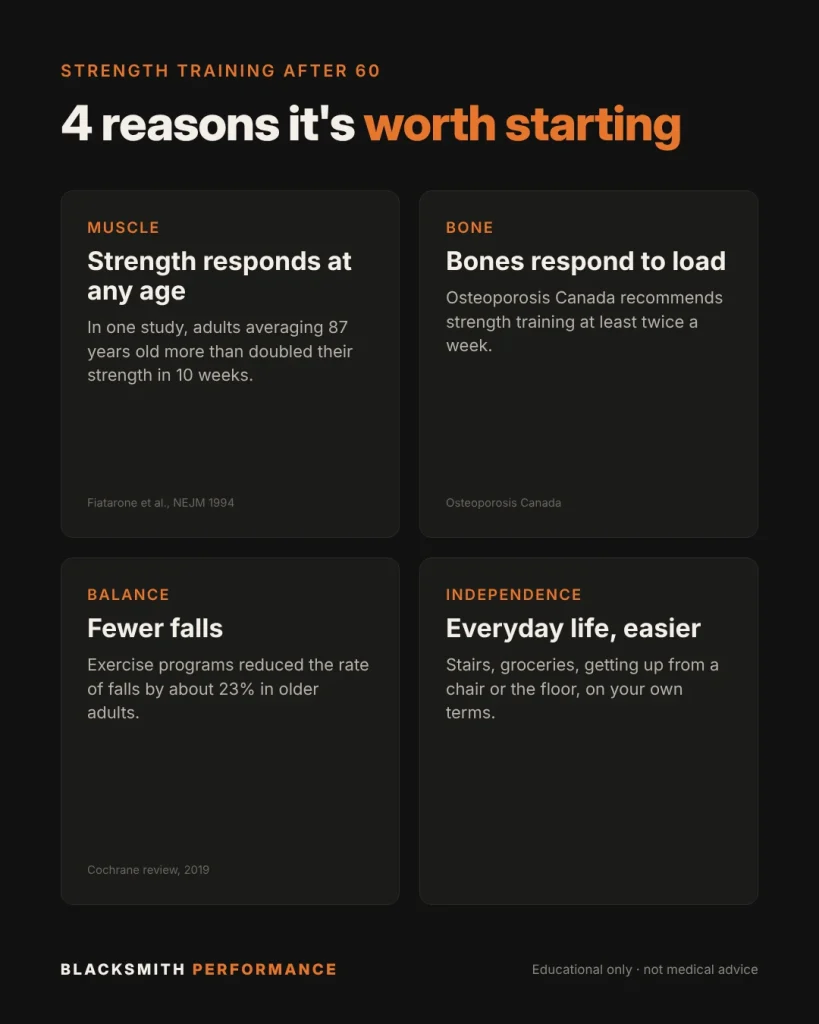
We naturally lose muscle and strength as we age, and inactivity speeds that up. The encouraging part is that muscle keeps responding to training well into later life. In a well-known study of frail nursing-home residents with an average age of 87, ten weeks of progressive resistance training increased muscle strength by 113% on average, and walking speed and stair-climbing power improved as well (Fiatarone et al., New England Journal of Medicine, 1994).
Your results will depend on your starting point and health, but the message is clear: strength can be built, not just maintained, after 60.
Bone health: loading your skeleton the right way
Bones respond to the forces placed on them. Osteoporosis Canada recommends strength training at least twice a week for people with osteoporosis, starting with body weight and progressing over time, along with exercises that support posture (Osteoporosis Canada, Too Fit to Fracture).
Research suggests that well-supervised, progressive training can be both safe and effective. In the LIFTMOR trial, postmenopausal women with low bone mass who completed eight months of supervised, twice-weekly high-intensity resistance and impact training improved spine and hip bone density and physical function compared with a low-intensity home program (Watson et al., Journal of Bone and Mineral Research, 2018). That program was carefully screened and closely supervised, so it is not a do-it-yourself plan, but it shows what good coaching can make possible.
Balance and fall prevention
Falls are the leading cause of injury among older adults in Canada, and between 20% and 30% of seniors fall each year (Parachute, citing CIHI and the Public Health Agency of Canada). In Toronto, winter sidewalks, streetcar steps and busy subway stairs add everyday balance challenges.
Exercise is one of the best-supported ways to lower that risk. A Cochrane review of 108 trials with more than 23,000 participants found that exercise reduced the rate of falls by about 23%, with the strongest evidence for programs built mainly on balance and functional exercises (Sherrington et al., Cochrane, 2019). A good trainer builds that work into every session, not as an afterthought.
Mobility and independence
Strength is what lets you get out of a low chair, step onto a curb, lift a suitcase into the overhead bin or carry a grandchild. Training these movements directly, in a safe and progressive way, helps you keep doing the things that matter to you on your own terms. Many older adults also find that training lifts their mood, energy and confidence.
How much exercise do adults over 65 need?
Canada’s 24-Hour Movement Guidelines for adults 65 and older recommend (CSEP):
- At least 150 minutes a week of moderate to vigorous aerobic activity, such as brisk walking
- Muscle-strengthening activities using the major muscle groups at least twice a week
- Physical activities that challenge balance
- Limiting sedentary time to 8 hours or less a day, and getting 7 to 8 hours of good-quality sleep
If that sounds like a lot, start where you are. Some activity is better than none, and a trainer can help you build up gradually.
Is it safe to start strength training after 60?
For most older adults, yes, when the program is well designed and progresses gradually. A few steps make it safer:
- Screen first. A good trainer will ask about your health before you start, often using a tool such as CSEP’s Get Active Questionnaire. Depending on your answers, they may recommend checking with your doctor first.
- Talk to your healthcare provider if you have heart or lung disease, uncontrolled blood pressure, diabetes with complications, osteoporosis with a past fracture, joint replacements, recent surgery, dizziness or balance problems, or any condition you are unsure about.
- See a physiotherapist first if you are recovering from an injury, fracture or surgery. A trainer can then build on that rehab.
- Stop and get help if you feel chest pain or pressure, unusual shortness of breath, dizziness, sharp joint pain or anything that feels wrong.
What to expect in your first personal training session
A first session for an older adult should feel welcoming and unhurried. It is about getting to know you, not testing your limits. At Blacksmith Performance, it usually looks like this:
- A conversation. Your goals, daily routine, activity history, any pain, and what you would like to do more easily.
- Health history and screening. Medications, conditions, past injuries and surgeries, plus any guidance from your doctor or physiotherapist.
- Simple movement and strength checks. For example, standing up from a chair, walking, a short balance hold and a gentle push and pull. These give us a safe baseline.
- A light sample workout. A few exercises at a comfortable effort so you can see how it feels.
- A plan. How often to train, what to focus on first and how progress will be measured.
Wear comfortable clothes and supportive shoes, bring water, your glasses if you need them and a list of your medications. Adult children are welcome to join the first session if that helps everyone feel comfortable.
How exercises are adapted to different abilities
Good senior fitness training meets you where you are. The same movement pattern can be made easier or harder:
- Squat: sit-to-stand from a raised chair, then a lower chair, then holding a light weight.
- Push: wall push-up, then an incline push-up on a bench, then a chest press with dumbbells or a machine.
- Pull: resistance-band row while seated, then a standing cable or dumbbell row.
- Balance: standing with feet together holding a counter, then heel-to-toe stance, then single-leg holds with support nearby.
- Carry: walking with light bags, building up to heavier loads, just like real-life groceries.
Programs are also adjusted for specific conditions. For osteoporosis, that can mean bending from the hips and knees rather than the spine, using slow and controlled movements and limiting repeated twisting, in line with Osteoporosis Canada’s guidance. For arthritis, it can mean choosing pain-free ranges and adjusting exercises on flare-up days. Some clients also pair training with Fascial Stretch Therapy, an assisted, table-based stretching session, to work on comfortable range of motion.
For adult children: helping a parent get started
Many of the people who search for a personal trainer for seniors in Toronto are doing it for a mom or dad. A few tips from experience:
- Lead with what they want to do, such as travelling, gardening, keeping up with grandchildren or staying in their home, rather than with worries about falling.
- Let them choose. Share two or three options and let your parent pick. People stick with what they chose.
- Offer to come to the first session and help with logistics like getting there, but give them space once they are comfortable.
- Share health information with their permission, and encourage them to tell their doctor they are starting a program.
- Start small. One or two sessions a week is plenty to begin with.
Questions to ask before choosing a personal trainer for seniors
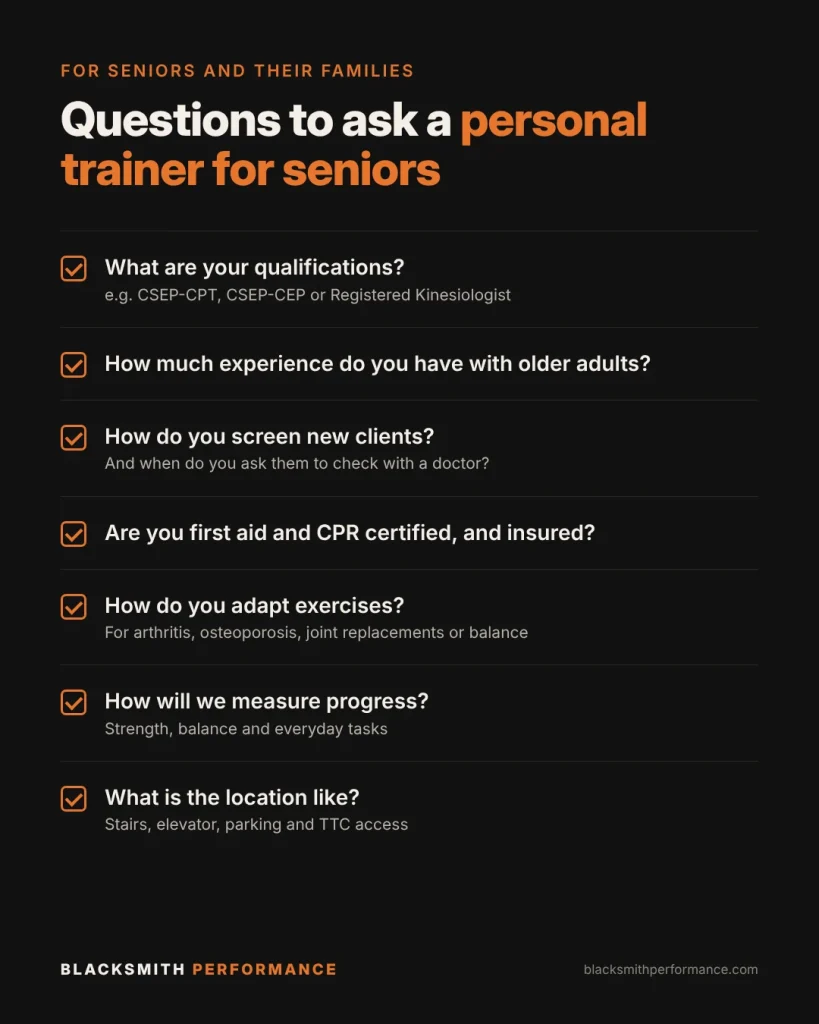
- What are your qualifications? Look for a recognized certification such as CSEP-CPT or CSEP-CEP, or a Registered Kinesiologist (R.Kin) in Ontario, which is a regulated health profession (College of Kinesiologists of Ontario).
- How much experience do you have with older adults? Ask about clients with conditions similar to yours.
- How do you screen new clients, and when do you ask them to check with a doctor first?
- Are you certified in first aid and CPR, and are you insured?
- How do you adapt exercises for arthritis, osteoporosis, joint replacements or balance issues?
- Will you communicate with my physiotherapist or doctor if I want you to?
- How will we measure progress? Strength, balance and everyday tasks, not just weight.
- What is the location like? Ask about stairs, elevators, parking and TTC access, and whether online or home-program options are available.
Red flags: no health questions before the first workout, pushing through pain, one-size-fits-all programs, or promises of fast results.
Personal trainer, physiotherapist or group class?
- Physiotherapist: best for diagnosing and treating pain, injury, or recovery after a fracture or surgery.
- Group fitness class: affordable and social, and a good fit if you are already active and don’t need much individual adjustment.
- Personal trainer: one-on-one attention, a program built around your health and goals, and steady progression. A great next step after physiotherapy, or if group classes feel too fast or too general.
Many people combine them, for example physiotherapy for a sore knee while a trainer builds overall strength, with both professionals on the same page.
Personal training for older adults at Blacksmith Performance
At Blacksmith Performance, we offer private personal training in downtown Toronto. Every program starts with a health and movement assessment, then focuses on what matters most for long-term independence: leg and grip strength, balance, posture and confidence in everyday movement. We progress at your pace, adjust around good and bad days, and are happy to work alongside your physiotherapist or doctor.
Between sessions, many clients follow a simple home routine we set up for them, and Fascial Stretch Therapy is available for those who want hands-on assisted stretching as part of their plan.
Personal Training for Seniors: Frequently Asked Questions
Is it safe for seniors to lift weights?
Usually, yes. Strength training is safe for most older adults when it starts with a health screening, uses loads you can control with good form and progresses gradually. Check with your doctor first if you have heart disease, uncontrolled blood pressure, recent surgery, a recent fracture or another medical condition.
Can you build muscle after 60 or 70?
Yes. Muscles respond to strength training at any age, and many people in their 60s, 70s and 80s gain strength within a few weeks. How much you gain depends on your health, starting point and consistency.
How often should a senior work with a personal trainer?
One or two sessions a week is a good start, with light activity such as walking on other days. Canada’s guidelines for adults 65 and older recommend muscle-strengthening activities at least twice a week, plus physical activity that challenges balance.
Can strength training help with osteoporosis?
Yes. Progressive strength training, balance work and safe impact exercise can support bone health and lower fall risk. Exercises should be adapted to protect the spine, and anyone with a recent fracture or high fracture risk should get advice from their doctor or a physiotherapist first.
Is it too late to start exercising at 70 or 80?
No. Strength, balance and mobility can improve at any age with a program matched to your abilities. Starting gently and building up gradually is the safest approach.
What should I bring to my first personal training session?
Wear comfortable clothes and supportive shoes, and bring water, your glasses if you need them, a list of your medications and health conditions, and any notes from your doctor or physiotherapist.
Is there one-on-one personal training for seniors in Toronto?
Yes. Blacksmith Performance offers one-on-one personal training for seniors in a private setting in downtown Toronto. Every client starts with a health and movement assessment, including a balance check, and gets a program built around their abilities, goals and medical history. Contact us to talk about whether it’s a good fit.
Can seniors do strength and balance training at home?
Yes. Many effective exercises need only a sturdy chair, a wall or counter and light weights or bands, such as sit-to-stands, wall push-ups, heel raises and supported balance holds. A trainer can design a home program, show you how to do it safely and progress it over time. Set up a clear space and keep something stable within reach.
What exercises help seniors with balance and coordination at home?
Simple options include standing with feet close together or heel-to-toe while holding a counter, heel and toe raises, side steps, sit-to-stands and slow marching in place. Practise near a counter or sturdy chair, start with support and reduce it only as you feel steady. Stop and talk to your doctor if you feel dizzy.
Can seniors with limited mobility exercise at home?
Yes. Seated and supported exercises can build strength and mobility safely, such as seated marches, seated leg extensions, arm raises with light weights or bands, and assisted sit-to-stands. A trainer adapts each exercise to your range of motion and progresses slowly. If you use a walker or have had a recent fall, check with your doctor or physiotherapist first.
Can a personal trainer help seniors after surgery?
Yes, once your surgeon or physiotherapist has cleared you. After surgery, rehabilitation usually starts with a physiotherapist. A personal trainer can then help you rebuild strength, balance and confidence safely, following your healthcare team’s guidance and any movement restrictions.
Can I get a customized senior workout plan at home if I live outside downtown, such as North York?
Yes. If travelling downtown isn’t practical, Blacksmith Performance can build a customized home workout plan through online coaching, with video check-ins to review your form and adjust the program. Some clients combine occasional in-person sessions with a home plan. Read more about online coaching vs in-person training.
Thinking about personal training for yourself or a parent?
There is no pressure and no commitment. If you have questions about whether personal training is right for you or someone you care about, get in touch with us. We are happy to talk through your goals, health considerations and what a first session would look like, and if another option would suit you better, we will tell you.
Health disclaimer: This article is for general education and is not medical advice. Talk to your doctor or another qualified healthcare professional before starting a new exercise program, especially if you have a medical condition, take medications that affect balance or blood pressure, or are recovering from an injury or surgery. Stop exercising and seek medical help if you have chest pain, severe shortness of breath, dizziness or fainting.