
Most HR teams don’t need convincing that employees sit too much and feel stretched thin. The harder question is which corporate fitness program people will actually use: group training, on-site stretch therapy or wellness workshops. Each format suits a different team, budget and calendar.
This guide compares the three main formats side by side, explains what affects the cost and the effort for your HR team, shows how to measure results and covers how to include hybrid and remote employees. If you already know you want a program, see our corporate wellness in Toronto services.
Quick answer: choose group training if you want regular, team-building activity; on-site stretch therapy if you want a high-uptake, low-effort perk that suits desk-based staff; and workshops if you want to build knowledge about sleep, stress and nutrition across a large or hybrid team. Many Toronto employers start with one format as a pilot, then combine them.
Key takeaways
- Corporate fitness programs work best when they fit into the workday: 20–30 minute sessions beat hour-long classes for attendance.
- Group training builds team connection; stretch therapy is the easiest win for desk-heavy teams; workshops reach the most people per session.
- Cost depends on format, length, frequency, team size and whether delivery is on-site or virtual.
- Measure participation, booking fill rate and employee feedback from the start.
- Virtual workshops and individual online coaching help include hybrid and remote staff.
What Is a Corporate Fitness Program?
A corporate fitness program is any employer-funded activity that helps staff move more, recover better or build healthy habits, delivered at work or online. In Toronto, programs are usually run by an outside workplace fitness coach or corporate personal trainer rather than an in-house gym, so they fit offices, coworking spaces and hybrid teams without building anything.
Why it matters: Canada’s guidelines recommend adults limit sedentary time to 8 hours or less a day and break up long periods of sitting (CSEP). For many office workers, the workday alone goes past that. A 2019 systematic review also found that workplace physical activity and nutrition programs can improve work outcomes such as absenteeism, especially when they include changes to the work environment, though the authors call for stronger long-term studies (Grimani et al., 2019).
The 3 Main Formats Compared
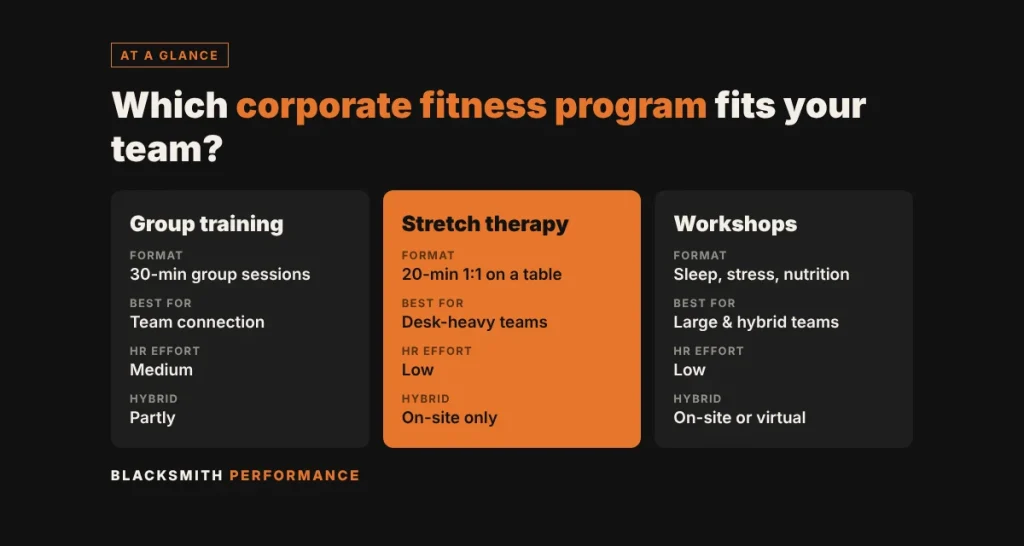
| Group training | On-site stretch therapy | Workshops | |
| What it is | 30-minute group sessions: mobility, strength, conditioning | 20-minute one-on-one assisted stretching appointments on a table | Interactive talks on sleep, stress, nutrition, movement at work |
| Best for | Teams that want regular activity and connection | Desk-heavy teams; quick, high-uptake perk | Large or hybrid teams; knowledge and habits |
| Fitness level needed | All levels, with scaled options | None | None |
| Space needed | Meeting room or open area | A small private room for the table | Any meeting room, or virtual |
| People reached per session | Small groups at a time | One at a time (booked in slots) | Many at once |
| HR effort | Medium: scheduling recurring sessions | Low: share a booking link | Low: book a room or a video call |
| Hybrid-friendly | Partly | On-site only | Yes, on-site or virtual |
Group training and small group personal training
Group training brings colleagues together for short, coached sessions that combine mobility, strength and conditioning. A good coach scales every exercise so beginners and regular exercisers can train side by side. Small group training (usually 4–12 people) gives more individual attention than a big class, which matters if your team has a wide mix of fitness levels or injuries.
- Pros: builds team connection, regular habit, works for most fitness levels.
- Cons: needs a recurring time slot and a space; attendance can drop without leadership support.
- Best for: teams that want a weekly or monthly ritual, or an active alternative to a standard team-building event.
On-site stretch therapy
With on-site stretch therapy, a qualified therapist sets up a treatment table in your office and employees book 20-minute one-on-one sessions of assisted stretching. It needs no gym clothes, no fitness experience and no sweat, so people can go straight back to work. It’s based on the same approach as our fascial stretch therapy sessions in the studio.
- Pros: very low barrier to take part, personal attention, easy to run as a half-day or full-day event.
- Cons: reaches one person at a time, so plan enough slots for demand.
- Best for: desk-heavy teams, busy periods such as year-end, conferences and appreciation days.
Wellness workshops
Workshops teach practical skills on topics such as sleep, stress and recovery, nutrition for busy professionals, movement at work and sustainable habits. They can run on-site as a lunch-and-learn or virtually, so they reach the whole team, including people working from home.
- Pros: reaches many people at once, easy to schedule, works for hybrid teams.
- Cons: knowledge alone doesn’t always change behaviour; pair it with an activity or follow-up.
- Best for: kicking off a wellness program, large teams and remote or hybrid staff.
Which Corporate Fitness Program Fits Your Team?
| Your situation | Start with |
| Mostly desk-based, little time to spare | On-site stretch therapy |
| Want a recurring team activity | Group training (small groups) |
| Large team or several locations | Workshops |
| Hybrid or remote-first team | Virtual workshops, plus optional online coaching |
| Conference, offsite or appreciation day | Stretch therapy stations or a short group session |
| Not sure yet | A one-off pilot, then survey your team |
Many employers combine formats over a year: for example, a workshop to launch the program, monthly group sessions and a stretch therapy day during the busiest season.
What Do Corporate Fitness Programs Cost?
Corporate wellness providers in Toronto usually quote per program rather than publishing set prices, because costs depend on what you need. The main factors are:
- Format: stretch therapy is priced by therapist time (half-day or full-day); group sessions and workshops by session.
- Length and frequency: a one-off event, a pilot or a recurring monthly program.
- Team size and number of sessions needed to give everyone a chance to take part.
- Location: on-site in Toronto, multiple offices or virtual.
- Extras: custom content, employee communications and post-program reporting.
Think about HR effort as part of the cost, too. A provider who handles scheduling, booking links and employee communications saves your team hours. Some employers also check whether employees can use a lifestyle spending account (LSA) for individual coaching; rules vary by plan, so confirm with your benefits provider.
How to Measure the Results
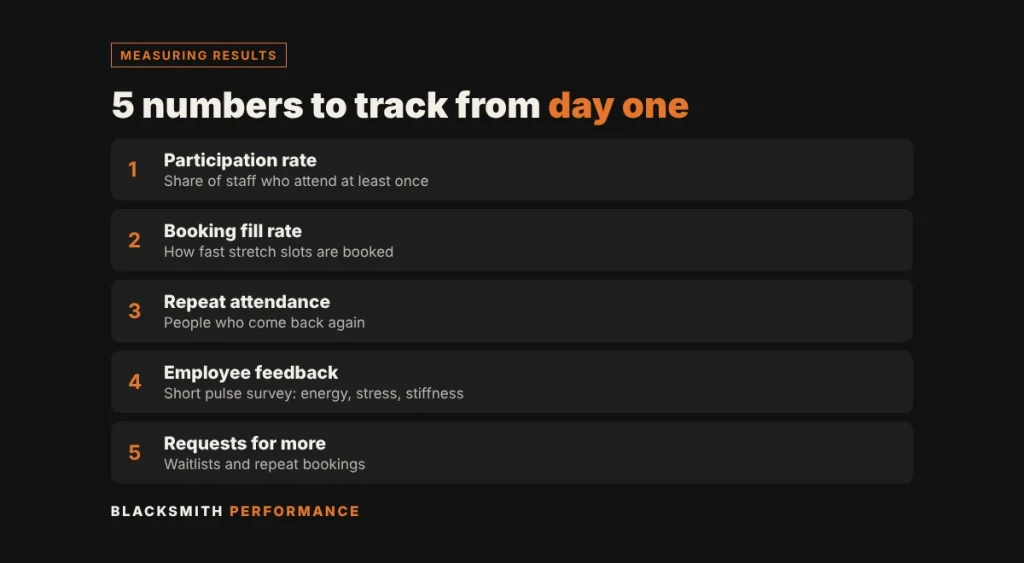
You don’t need complex ROI models to show whether a program is working. Track a few simple numbers from day one:
- Participation rate: the share of eligible employees who attend at least once.
- Booking fill rate: for stretch therapy, how many slots are booked and how fast.
- Repeat attendance: how many people come back for a second or third session.
- Employee feedback: a short pulse survey on energy, stress, stiffness and whether they’d recommend it.
- Requests for more: waitlists and requests for another session are a strong signal.
Over a longer period, you can compare these with existing HR data such as engagement survey scores or absence trends, but keep claims modest: many things affect those numbers.
How Online Coaching Works for Hybrid Teams
Hybrid and remote employees often miss out on office-based perks. Two options help include them:
- Virtual workshops: the same sleep, stress, nutrition and movement topics, delivered by video so everyone can join.
- Individual online coaching: employees get a personalized program, check-ins and form feedback through online fitness coaching, so they can train at home, at a gym or while travelling.
For tips you can share with remote staff, see our remote worker’s guide to staying fit. We also wrote about what employers should know as more staff use GLP-1 medications in our guide to Ozempic muscle loss.
[PLACEHOLDER: CONFIRM WITH WILL] Whether online coaching can be offered as a company-paid employee perk, and how that’s billed.
Corporate Wellness With Blacksmith Performance
Blacksmith Performance brings on-site stretch therapy, 30-minute movement and fitness sessions and wellness workshops to Toronto offices, agencies, professional services firms, headquarters and coworking spaces. Sessions are led by Will Haywood, a canfitpro-certified trainer, Fascial Stretch Therapist and Precision Nutrition Level 2 coach, who led the stretch break at HRPA’s HR Law 2026 conference in Toronto.
We handle the planning, booking and communications, deliver on-site and follow up with feedback and next steps, whether you want a one-off activation, a pilot or a recurring program. Learn more about our workplace wellness programs.
Corporate Fitness Programs: FAQs
What should a corporate fitness program include?
A good corporate fitness program includes activities employees can join during the workday, such as short group training, on-site stretch therapy or wellness workshops, plus a simple way to book, clear communication and a way to collect feedback. Programs that fit into 20–30 minutes get the best attendance.
Is on-site stretch therapy or group training better for employees?
It depends on your team. On-site stretch therapy needs no fitness experience or gym clothes, so it suits desk-based teams and busy periods. Group training builds team connection and a regular habit, so it suits teams that want a recurring activity.
How much does a corporate wellness program cost in Toronto?
Most providers quote per program because cost depends on the format, session length, frequency, team size and whether delivery is on-site or virtual. Request a proposal with your team size and goals to get an accurate quote.
How do you measure the success of a workplace fitness program?
Track participation rate, booking fill rate, repeat attendance and short employee feedback surveys. Waitlists and requests for more sessions are strong signs a program is working.
Can corporate wellness programs include remote and hybrid employees?
Yes. Wellness workshops can be delivered virtually, and individual online fitness coaching lets remote employees follow a personalized program at home or at their own gym.
Choosing the Right Format
There’s no single best corporate fitness program. Stretch therapy wins on ease and uptake, group training on team connection and workshops on reach. Start with the format that fits your team’s days, measure participation and feedback, and build from there.
Request a corporate wellness proposal. Book a discovery call and we’ll recommend the right mix of stretch therapy, group training and workshops for your team.