
Ozempic can make eating less feel dramatically easier. Hunger quiets down, cravings ease and the scale finally starts to move. But many people in Toronto now ask a harder question: is some of that weight coming from muscle?
Yes, Ozempic muscle loss can happen. When you lose weight quickly on any GLP-1 medication, part of what you lose is lean mass, not just fat. The good news is that strength training two to three times a week, enough protein and tracking more than the scale give you real control over how much muscle you keep.
This guide explains what the research shows, why rapid weight loss puts muscle at risk, and the practical plan our coaches use with clients on Ozempic, Wegovy, Mounjaro and generic semaglutide.
Key takeaways
- Ozempic doesn’t “attack” muscle directly. Muscle loss comes mainly from eating much less and losing weight fast.
- In clinical trials, lean mass made up roughly a quarter to a third of total weight lost on GLP-1 medications. Lean mass includes muscle, organs and water, not muscle alone.
- Strength training at least twice a week, ideally two to three, is the most reliable way to protect muscle and strength.
- Protein gets harder to eat when appetite drops. Make it the first thing on your plate.
- Track strength, energy and body measurements, not just weight. Your coach handles training; your prescriber handles the medication.
Does Ozempic cause muscle loss?
Ozempic (semaglutide) works mainly by reducing appetite and slowing digestion, so most people eat a lot less. Any large calorie deficit, whether from medication, dieting or surgery, causes some loss of lean mass along with fat. So the medication causes muscle loss indirectly, through the weight loss it produces.
Here is what the main studies found:
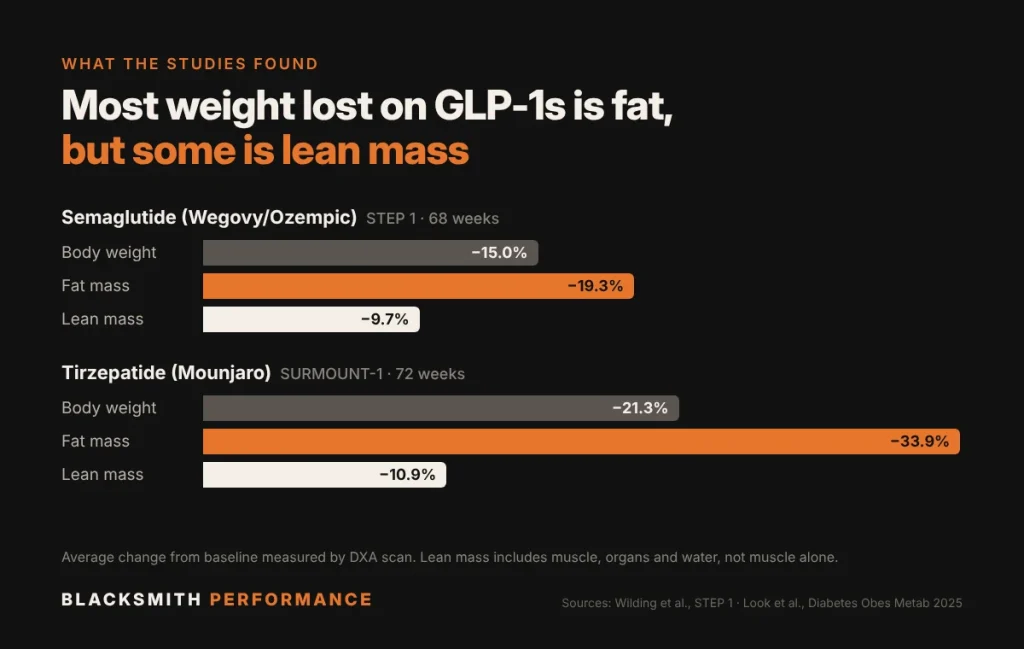
- Semaglutide (STEP 1 trial): in a body-composition substudy of 140 adults, people on semaglutide 2.4 mg lost 15% of their body weight over 68 weeks. Fat mass fell by 19.3% and lean mass by 9.7%. Because fat dropped faster, the share of the body made up of lean mass actually went up. (Wilding et al., STEP 1 body composition analysis)
- Tirzepatide (SURMOUNT-1 trial): people lost 21.3% of their body weight over 72 weeks. About 75% of the weight lost was fat and about 25% was lean mass. (Look et al., Diabetes, Obesity and Metabolism, 2025)
- Muscle size vs. strength: a 2025 study in mice found that much of the lean mass lost on semaglutide came from organs like the liver rather than skeletal muscle, but some muscles lost strength even when their size barely changed. The researchers stress that this was an animal study and human strength data are still needed. (University of Utah Health, 2025)
The takeaway: losing some lean mass is expected, and for many people body composition still improves overall. What matters is keeping that loss as small as possible and protecting strength and function, especially if you are over 60.
Why rapid weight loss puts muscle at risk
Muscle is expensive tissue for the body to keep. When food intake drops sharply, the body is more willing to break some of it down, especially if it isn’t getting a clear signal that the muscle is still needed. On a GLP-1, several things tend to stack up:
- A large calorie deficit. Faster weight loss generally means more lean mass lost alongside fat.
- Low protein intake. Smaller appetites usually mean smaller portions of everything, including protein.
- Less movement. Fatigue or nausea can make it easy to skip workouts.
- Age. Adults over 60 already lose muscle more easily, so the margin for error is smaller.
Warning signs worth watching: feeling weaker or more tired than usual, lifts or daily tasks getting harder, dizziness, feeling unusually cold, poor recovery, hair shedding or a near-total loss of interest in food. These are not a diagnosis, but they are reasons to review the plan and talk to your prescriber.
How to keep your muscle on Ozempic: a 3-part plan
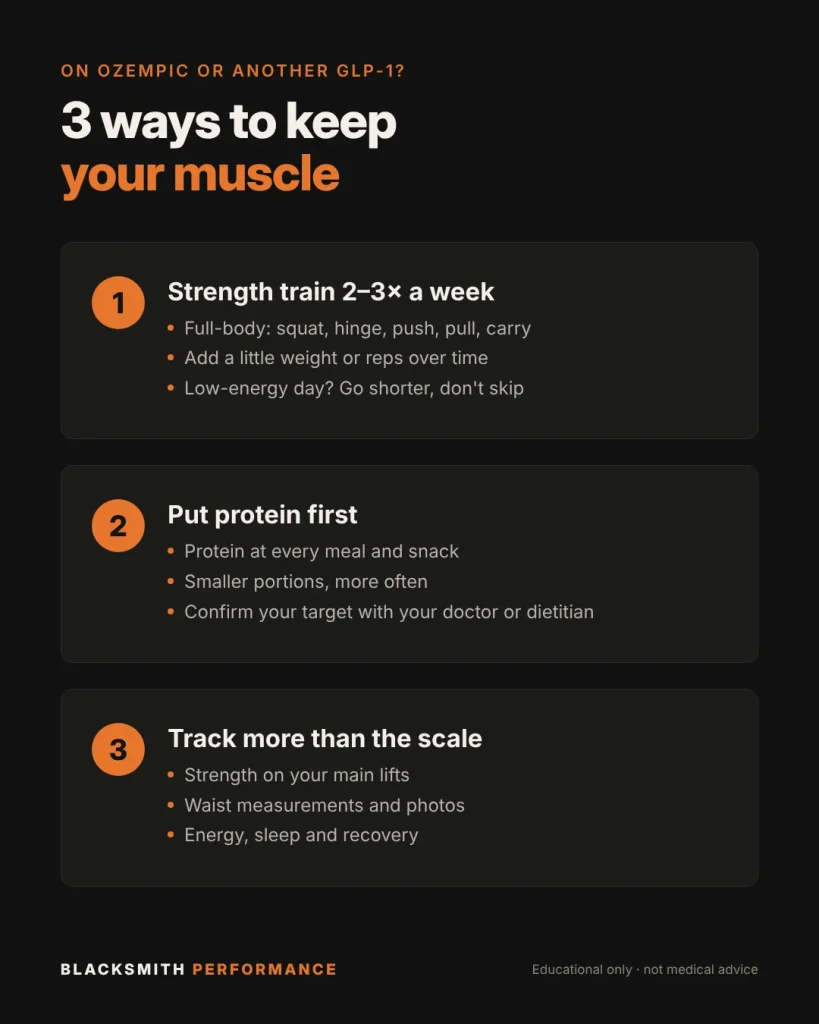
Major nutrition and obesity organizations now recommend pairing GLP-1 therapy with adequate protein and strength training to preserve lean mass (joint advisory from four US obesity and nutrition societies, 2025). Canada’s obesity guidelines also note that weight-loss programs that include exercise generally maintain or even increase fat-free mass (Obesity Canada, Physical Activity in Obesity Management). In practice, that comes down to three habits.
1. Strength train 2–3 times a week
Resistance training is the clearest signal you can send your body that muscle is still needed. Canada’s 24-Hour Movement Guidelines recommend muscle-strengthening activities for the major muscle groups at least twice a week (CSEP). For people losing weight on a GLP-1, two to three sessions is a practical target.
- Use full-body sessions built on basic movements: squat or leg press, hinge (like a Romanian deadlift), push, pull and a carry or core exercise.
- Work in a range where the last few reps feel challenging but your form stays clean.
- Add a little weight or a few reps over time. Progress, even slow progress, is what keeps muscle.
- On low-energy or nausea days, do a shorter session rather than skipping it. Consistency beats intensity.
Never trained before, or managing an injury or health condition? A coach can set safe starting loads and adjust the plan as your body changes. Our personal training in downtown Toronto starts with exactly this.
2. Make protein the first thing on your plate
Protein gives your body the building blocks to maintain muscle, but it is often the first thing to drop when appetite falls. A 2024 review by obesity medicine experts suggested more than 60–75 g of protein a day, or about 0.8–1.5 g per kilogram of body weight, for people on anti-obesity medications (Neff et al., Obesity, 2024). Your own target depends on your body size, health and kidney function, so confirm it with your doctor or a registered dietitian.
- Start each meal with a clear protein source, then add vegetables, carbs and fats as you can tolerate them.
- Eat smaller portions more often if big meals feel uncomfortable. A palm-sized portion of protein each time you eat is a simple starting point.
- Keep easy options on hand: Greek yogurt, cottage cheese, eggs, fish, chicken, tofu, lentils or a simple protein shake.
- Drink enough fluids. Fullness and nausea make it easy to fall behind, and staying hydrated helps with cramps and fatigue (Cleveland Clinic).
3. Track progress beyond the scale
The scale can’t tell fat loss from muscle loss. A better dashboard shows whether the weight you are losing is the weight you want to lose:
- Strength: log your main lifts. Holding or increasing strength is one of the best signs you are keeping muscle.
- Measurements: waist, hips and progress photos every two to four weeks.
- Energy, sleep and recovery: a quick weekly rating from 1 to 5.
- Protein and training consistency: how many days you hit your protein target and how many sessions you completed.
- Body composition (optional): a DEXA scan or a consistent bioimpedance scale can help, but take readings under the same conditions each time.
If weight is dropping while strength and energy are falling with it, the plan needs adjusting. That is a conversation for both your coach and your prescriber.
What happens to your muscle if you stop Ozempic?
Appetite usually comes back when the medication stops. In the STEP 1 extension, people who stopped semaglutide regained about two-thirds of the weight they had lost within a year (Wilding et al., Diabetes, Obesity and Metabolism, 2022). The strength and habits you build now are what help you hold on to your results.
Build these habits while you are still on the medication:
- A small set of repeatable, protein-forward meals
- A strength routine that survives busy weeks
- A plan for travel, social events and high-stress periods
- Regular self-monitoring without obsession
- A clear follow-up plan with your medical team before any dose change
Never stop or change your medication without talking to your prescriber.
Ozempic, Wegovy and generic semaglutide in Canada
In Canada, Ozempic is approved for type 2 diabetes, while Wegovy, which also contains semaglutide, is approved for chronic weight management alongside diet and physical activity (Health Canada). In 2026, Health Canada began approving generic semaglutide products, including the first generic for weight management (Global News). As access grows, more Torontonians are starting these medications, and protecting muscle along the way matters just as much as the number on the scale.
How Blacksmith Performance coaches clients on GLP-1 medications
We coach busy professionals in downtown Toronto and online across Canada, and a growing number of our clients are using a GLP-1. Our role is simple: help you keep your strength, muscle and energy while the medication does its job. Here is how it works:
- Assessment first. We look at your training history, current strength, schedule, appetite and any guidance from your medical team.
- A strength plan built for your energy levels. Two to three sessions a week, adjusted around side effects, travel and busy weeks.
- Protein and meal habits that fit a smaller appetite. Practical meal structures, not rigid meal plans.
- Regular check-ins on the full dashboard. Strength, measurements, energy and recovery, not just weight.
- Clear boundaries. We never recommend, change or stop medication. We encourage you to keep your prescriber informed and we refer you back to them when something needs medical attention.
Prefer to train in person? Our personal training sessions happen in downtown Toronto. Short on time or outside the city? Online fitness coaching gives you the same program and check-ins through an app, from anywhere in Canada. We also run programs for employers who want to support staff using GLP-1 medications.
Coaching and medical care have different jobs
A qualified coach helps with daily behaviours: training, meal structure, planning, accountability and problem-solving. A coach should not recommend a medication, change a dose, advise you to stop treatment or diagnose a medical problem.
Get prompt medical attention for persistent vomiting, severe or worsening abdominal pain, inability to stay hydrated, fainting, repeated dizziness, extreme weakness or any other concerning symptom. Medication questions belong with your prescriber or pharmacist.
Ozempic muscle loss: frequently asked questions
Does Ozempic cause muscle loss?
Yes, it can. Ozempic doesn’t break down muscle directly, but the rapid weight loss it produces includes some lean mass along with fat. Strength training and enough protein are the most practical ways to limit that loss.
How much muscle do you lose on Ozempic?
It varies from person to person. In clinical trials of GLP-1 medications, lean mass made up roughly a quarter to a third of the total weight lost. Lean mass includes organs and water as well as muscle, so not all of it is muscle tissue.
Can you build muscle while on Ozempic?
Many people can maintain muscle, and some gain a little, with consistent strength training and enough protein. Building significant muscle is harder in a large calorie deficit, so the main goal on a GLP-1 is to keep the muscle you have and stay strong.
How much protein should I eat on Ozempic?
Expert reviews suggest more than 60–75 g a day, or about 0.8–1.5 g per kilogram of body weight, for people on anti-obesity medications. Your doctor or a registered dietitian can set the right target for you.
Can Ozempic cause muscle pain or cramps?
Cramps and fatigue can happen when food and fluid intake drop, and staying hydrated may help. Don’t assume muscle pain is normal, though. Tell your prescriber about any new or persistent muscle pain, cramps or weakness.
What happens to muscle when you stop Ozempic?
Appetite often returns and weight regain is common. Keeping up strength training and protein habits before and after stopping helps you hold on to the muscle you have built and maintained.
Where can I get help keeping muscle on Ozempic in Toronto?
Blacksmith Performance offers strength and nutrition coaching for people using GLP-1 medications, with in-person personal training in downtown Toronto and online coaching anywhere in Canada. Coaching works alongside your doctor, not in place of them.
The bottom line
GLP-1 medications are powerful tools, not shortcuts and not a failure of willpower. Like any tool, the result depends on what you build around it. Successful weight loss should leave you stronger and more capable, not just lighter: able to train, work, travel and live with confidence for years to come.
At Blacksmith Performance, we care about what you are becoming while the weight comes off, not only what the scale says.
Keep your strength on your GLP-1
If you are using Ozempic or another GLP-1 and want a strength and nutrition plan that works alongside your medical care, contact us or book a free strategy call. We will build a plan around your goals, schedule and energy.
Medical disclaimer: This article is for general education only and is not medical advice. It does not replace advice from your doctor, pharmacist or registered dietitian. Always talk to your healthcare professional before starting, stopping or changing any medication, diet or exercise program, especially if you have a medical condition or are experiencing side effects.