
Ask three corporate wellness providers for a quote and you may get three completely different answers: one priced per employee per month, one per half-day and one as a yearly package. That makes the cost of corporate wellness programs hard to compare.
This guide breaks down what corporate wellness programs cost in Canada, the four common pricing models, what drives the price, example budgets and what the research says about return on investment. New to the topic? Start with what is a corporate wellness program, or see our corporate wellness programs in Toronto.
Quick answer: a full corporate wellness program in Canada typically costs about $300 to $3,000 or more per employee per year, depending on company size and what’s included. An employee assistance program (EAP) on its own runs about $3–$10 per employee per month, and on-site services such as massage or stretch days are usually priced per session or per half-day.
Corporate Wellness Program Cost at a Glance
These are published 2026 figures from Canadian providers and guides. Treat them as starting points: prices vary by provider, city and what’s included, and HST is usually extra.
| Item | Typical price | Source |
|---|---|---|
| Full program, under 15 employees | $300–$600 per employee per year | HRXconnect (Ontario guide) |
| Full program, 15–50 employees | $600–$1,200 per employee per year | HRXconnect |
| Full program, 50–150 employees | $1,000–$2,000 per employee per year | HRXconnect |
| Full program, 150+ employees | $1,500–$3,000+ per employee per year | HRXconnect |
| Employee assistance program (EAP) | $3–$10 per employee per month | HRXconnect |
| Wellness spending account | Usually $500–$2,500 per employee per year | HRXconnect |
| On-site massage program | $18–$50 per employee per session; half-day from $549 | HyperTherapy (one provider, 2026) |
| Corporate chair massage | $120 per hour, 1-hour minimum | Massage Club (one provider) |
Sources: HRXconnect, HyperTherapy, Massage Club.
4 Corporate Wellness Pricing Models
1. Per employee per month (PEPM)
You pay a set fee for every employee, whether or not they use the service. This is how most EAPs, wellness apps and digital platforms are priced.
- Pros: predictable, easy to budget, scales with headcount.
- Cons: you pay for employees who never use it; uptake for apps is often low.
- Best for: always-on support such as counselling and mental health resources.
2. Per session, half-day or full-day
You pay for a provider’s time on-site or online: a 30-minute group session, a workshop, or a half-day or full-day of stretch therapy or massage appointments.
- Pros: you only pay for what you book; easy to pilot.
- Cons: costs rise with frequency; you need to plan enough slots for demand.
- Best for: on-site services, events, appreciation days and pilots.
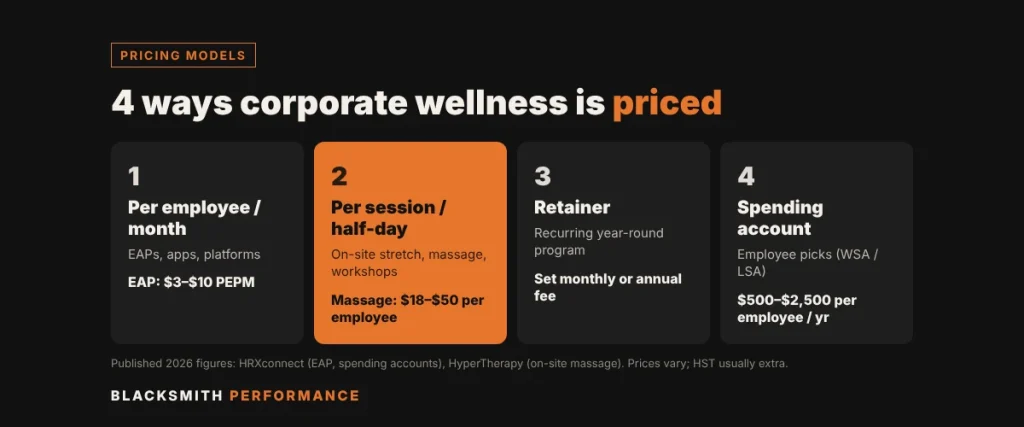
3. Retainer or recurring program
A monthly or annual fee covers a set schedule, such as weekly group sessions plus a quarterly stretch day and workshops, often at a lower rate than booking each one separately.
- Pros: consistent programming, usually a better rate, less admin.
- Cons: longer commitment; review uptake regularly.
- Best for: employers who’ve run a successful pilot and want a year-round program.
4. Spending accounts (WSA or LSA)
You give each employee a set budget to spend on approved wellness expenses, such as gym memberships, personal training or mental health apps. Budgets typically range from about $500 to $2,500 per employee per year (HRXconnect).
- Pros: flexible; employees choose what helps them.
- Cons: no shared team experience; usually a taxable benefit; check with your benefits provider or accountant.
- Best for: diverse or remote teams.
What Drives the Cost of Corporate Wellness Programs?
- Format: one-on-one services (stretch therapy, massage) cost more per person than group sessions or workshops.
- Team size and participation: how many sessions you need so everyone who wants a spot gets one.
- Length and frequency: a one-off event, a quarterly program or weekly sessions.
- On-site vs virtual: on-site adds travel and setup; virtual workshops cost less to deliver.
- Customization and reporting: tailored content and participation reports add value and cost.
- Taxes and fees: HST usually applies; some providers add travel fees outside the downtown core.
To compare formats such as group training, stretch therapy and workshops, see our guide to corporate fitness programs.
Example Corporate Wellness Budgets
These illustrative examples use the published ranges above. Your actual quote will depend on the provider and what you include.
A 25-person Toronto office
- Quarterly on-site stretch or massage day (4 half-days a year)
- Two virtual workshops a year, such as stress and sleep, or financial wellness
- Existing EAP through your benefits plan
At HyperTherapy’s published $18–$50 per employee per session, a quarterly massage program for 25 people would cost roughly $1,800–$5,000 a year before tax, before workshops (HyperTherapy).
A 100-person office
- Monthly 30-minute group movement sessions
- Quarterly stretch therapy days
- A lunch-and-learn series and an EAP
At this size, published guides suggest total wellness spending of roughly $1,000–$2,000 per employee per year for a fuller program, including benefits such as an EAP and spending accounts (HRXconnect). On-site services are usually a small part of that total.
Corporate Wellness ROI: What the Research Says
The return on corporate wellness programs is real but uneven, and it usually takes time:
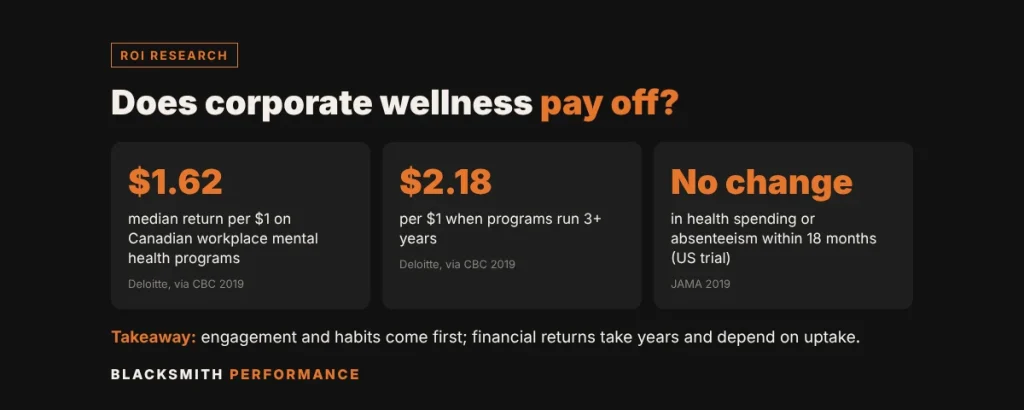
- Canadian mental health programs: a Deloitte study of Canadian companies found a median return of $1.62 for every $1 invested in workplace mental health programs, rising to $2.18 for programs running three years or more (CBC News on Deloitte, 2019).
- Older US meta-analysis: a 2010 review found medical costs fell about $3.27 and absenteeism costs about $2.73 for every dollar spent on wellness programs, but most studies were observational (Baicker et al., Health Affairs, 2010).
- Randomized trial: a large 2019 US trial found more employees reported exercising regularly, but no significant change in health spending or absenteeism within 18 months (Song & Baicker, JAMA, 2019).
The takeaway: expect benefits like engagement, morale and healthier habits first, and financial returns more slowly. Programs that run for several years and that employees actually use are the ones most likely to pay off. Employers are planning for this too: see our corporate wellness trends for 2027.
How to Measure ROI on Corporate Wellness Programs
In the first 3–6 months, track:
- Participation rate (share of eligible employees who take part)
- How quickly sessions fill and how many people come back
- Short pulse surveys on energy, stress and satisfaction
Over 12 months or more, compare:
- Absence days, engagement survey scores and staff turnover
- EAP and benefits usage trends (where your provider reports them)
A simple cost check: divide the total program cost by the number of employees who took part. A $3,000 stretch day with 60 participants costs $50 per participant, which is easy to compare with other perks.
Blacksmith Performance Corporate Wellness Pricing
Blacksmith Performance offers corporate wellness for Toronto workplaces in formats that are easy to budget for:
- On-site stretch therapy: half-day and full-day events with bookable 20-minute one-on-one sessions, all equipment provided. Based on our fascial stretch therapy approach.
- 30-minute group movement sessions: mobility, strength and conditioning for all levels.
- Workshops, on-site or virtual: sleep, stress and recovery, nutrition, financial wellness, movement at work and sustainable habits.
- One-off events, pilots or recurring programs.
[CLIENT INPUT: add “from” prices for a half-day and full-day stretch event, a group session and a workshop, or keep the line below.]
Every team is different, so we price based on your team size, goals and schedule. Book a discovery call and we’ll send a clear quote for our corporate wellness packages.
Corporate Wellness Cost: FAQs
How much does a corporate wellness program cost per employee in Canada?
Published Canadian guides put a full corporate wellness program at about $300 to $3,000 or more per employee per year, depending on company size and what’s included. A single on-site service is usually priced per session; one provider lists $18–$50 per employee per session.
What are the main corporate wellness pricing models?
The four common pricing models are per employee per month (used by EAPs and apps), per session or per half-day (used for on-site services), a retainer for a recurring program, and spending accounts where each employee gets a set wellness budget.
Is a corporate wellness program worth the cost?
It can be, especially when employees actually use it and it runs for several years. Benefits like engagement, morale and healthier habits usually show up first, and financial returns more slowly. Start with a pilot and measure participation and feedback.
What is the ROI of corporate wellness programs?
Results vary. A Deloitte study of Canadian companies found a median return of $1.62 for every $1 invested in workplace mental health programs, and $2.18 for programs running three years or more. A large 2019 US trial found no short-term change in health spending, so set realistic expectations.
Do corporate wellness services include HST in Ontario?
Usually not. Most providers quote prices before HST, so add 13% in Ontario. Some wellness perks can also be a taxable benefit for employees, so check with your accountant or benefits provider.
Budget Smart, Start Small
The cost of corporate wellness programs ranges widely, but you don’t need a big budget to start. Pick one format your team wants, run a pilot, measure participation and feedback, and build from there.
Book a corporate wellness discovery call to get a quote for a workplace wellness program for your team.