
In 2025, 42% of Canadians named money as their leading source of stress, and 17% named work (FP Canada, 2025). Add long days at a desk and it’s no surprise more employers are asking what a corporate wellness program is, and whether one would actually help their team.
This guide explains what a corporate wellness program is, the five main types, the benefits for employees and employers, what the research says about whether they work, and six examples you can adapt. If you’re already planning one, see our corporate wellness in Toronto services.
Quick answer: a corporate wellness program is a set of employer-supported activities, resources and policies that help employees stay physically, mentally and financially healthy, such as fitness sessions, stress workshops, nutrition coaching or financial education. The best programs fit into the workday, are voluntary and are measured by participation and employee feedback.
What Is a Corporate Wellness Program?
A corporate wellness program (also called a workplace or employee wellness program) is anything an employer offers to help staff look after their health and wellbeing. It can be as simple as a monthly stretch session or as broad as a year-round program covering fitness, mental health, nutrition and money.
What it isn’t: a gym discount on its own, or a replacement for fair workloads, good benefits and a psychologically safe workplace. Wellness programs work best on top of those foundations, not instead of them.
Programs are usually delivered in one of four ways:
- In-house: organized by HR or a wellness committee.
- An outside provider: coaches, therapists or speakers who come on-site or run sessions online.
- Through benefits: an employee assistance program (EAP) or a lifestyle spending account (LSA).
- Apps and platforms: digital challenges, meditation or fitness apps.
Why Corporate Wellness Matters
The importance of corporate wellness comes down to how much of our health is shaped by work. A few corporate wellness statistics for Canada:
- Sitting: Canada’s guidelines recommend adults limit sedentary time to 8 hours or less a day and break up long periods of sitting (CSEP). For desk workers, the workday alone often goes past that.
- Mental health: about 21.4% of Canada’s working population experience mental health problems, and businesses lost more than $6 billion in 2011 to related absenteeism, presenteeism and turnover (Mental Health Commission of Canada, 2013; older data, but still widely used).
- Money: 42% of Canadians say money is their top source of stress, more than health (21%) or work (17%) (FP Canada, 2025).
5 Types of Corporate Wellness Programs
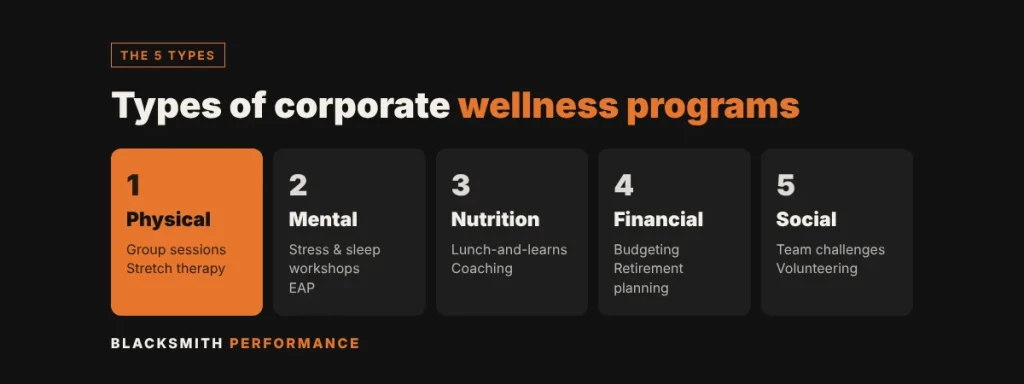
Most programs combine several of these types. Starting with one or two and adding more based on feedback is usually more successful than launching everything at once.
1. Physical wellness
Activities that get people moving and ease the aches of desk work: group fitness sessions, on-site stretch therapy, movement breaks and step challenges. These are often the most visible part of a program and the easiest to join. For a detailed comparison of formats, see our guide to corporate fitness programs.
2. Mental wellness
Support for stress, sleep and mental health: workshops on stress and recovery, sleep education, manager training and clear promotion of your EAP. In Canada, the voluntary CSA Z1003 National Standard for Psychological Health and Safety in the Workplace gives employers a framework for this side of wellness.
3. Nutrition
Help with everyday eating: lunch-and-learns, healthier food at work and individual nutrition coaching. Good nutrition programs focus on practical habits for busy professionals. Medical nutrition therapy for conditions like diabetes is the job of a registered dietitian.
4. Financial wellness
Education that reduces money stress: workshops on budgeting, debt, saving and planning for retirement, plus guidance on making the most of workplace benefits such as group RRSPs or an LSA. Given how many Canadians name money as their top stressor, this is one of the most valued types.
5. Social wellness
Activities that build connection: team challenges, volunteering days, community events and peer support groups. Social programs matter most for hybrid and remote teams, where people see each other less.
| Type | Example activities | HR effort | Works for hybrid? |
| Physical | Group sessions, on-site stretch therapy, step challenges | Low to medium | Partly |
| Mental | Stress and sleep workshops, EAP promotion, manager training | Low | Yes |
| Nutrition | Lunch-and-learns, nutrition coaching | Low | Yes |
| Financial | Budgeting and retirement workshops | Low | Yes |
| Social | Team challenges, volunteering, events | Medium | Partly |
Benefits of Corporate Wellness Programs
For employees
- More movement and less stiffness from long days at a desk.
- Practical skills for managing stress, sleep, food and money.
- Feeling that their employer cares, which supports morale.
- Habits that carry over outside work.
For employers
- A stronger employer brand and a perk that supports hiring and retention.
- Opportunities for teams to connect, especially in hybrid workplaces.
- A possible effect on productivity and absenteeism: a 2019 systematic review found workplace physical activity and nutrition programs can improve work outcomes, especially when they include changes to the work environment, though the evidence quality was mixed (Grimani et al., 2019).
Do Corporate Wellness Programs Work?
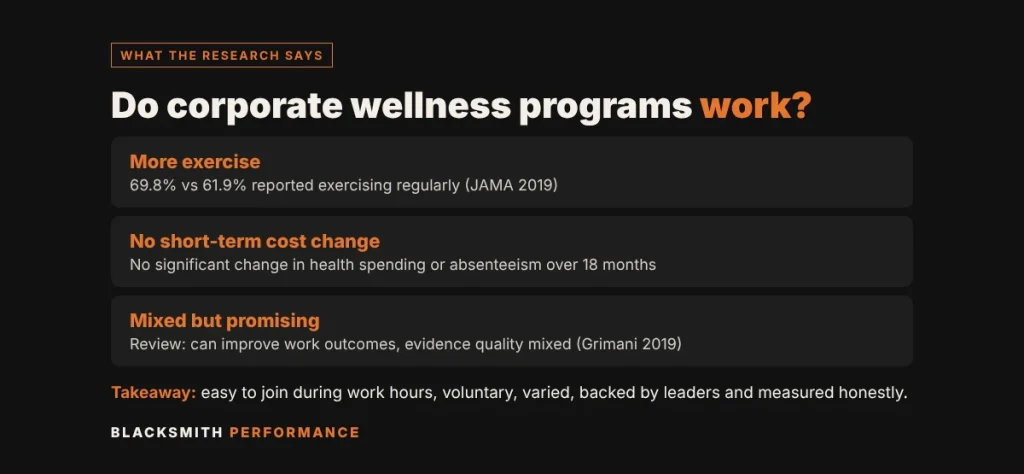
Honest answer: they can, but results depend on design, and short-term financial returns are often smaller than vendors claim.
- The largest randomized trial, run across 160 worksites with nearly 33,000 employees over 18 months, found employees in the program were more likely to report exercising regularly (69.8% vs 61.9%) and actively managing their weight. It found no significant change in clinical measures such as blood pressure, in health spending or in absenteeism during that time, and only 35% of eligible employees took part (Song & Baicker, JAMA, 2019).
- The 2019 review above found positive signals for productivity and work ability, with a call for better long-term studies (Grimani et al., 2019).
The takeaway: corporate wellness programs work best when they’re easy to join during the workday, voluntary, varied and backed by leaders, and when employers measure participation and feedback honestly instead of promising a dollar return.
6 Corporate Wellness Program Examples
Examples 2–6 are common program formats you can adapt; example 1 is one we delivered.
1. A stretch break at a conference
Will Haywood of Blacksmith Performance led the afternoon stretch break at HRPA’s HR Law 2026 conference in Toronto. A short, guided break gave attendees a chance to move and reset between sessions, without changing clothes or leaving the room. It works for events, offsites and all-hands meetings.
[PLACEHOLDER: CONFIRM WITH WILL] Add an approved photo and, if available, a short quote from the organizers.
2. Bookable on-site stretch therapy days
A therapist sets up a treatment table in the office and employees book 20-minute one-on-one assisted stretching sessions. No gym clothes or fitness experience needed, so uptake is high among desk-heavy teams. Learn more about on-site stretch therapy and fascial stretch therapy.
3. Weekly 30-minute group movement sessions
A coach leads short mobility, strength and conditioning sessions in a meeting room, scaled for all fitness levels. A regular time slot builds a habit and gives colleagues a reason to connect.
4. A lunch-and-learn series
A monthly session on sleep, stress and recovery, nutrition for busy professionals or movement at work. Lunch-and-learns reach many people at once and can run on-site or virtually.
5. A financial wellness workshop
A practical session on budgeting, managing debt and making the most of workplace benefits. Because money is Canadians’ top stressor, this is often one of the best-attended topics.
6. A team activity challenge for hybrid staff
A four-week step or activity challenge with team leaderboards and weekly virtual check-ins. It includes remote employees and adds a social element. For tips to share with remote staff, see our remote worker’s guide to staying fit.
How to Tell If Your Wellness Program Is Working
Track five simple numbers from day one:
- Participation rate: the share of eligible employees who take part at least once.
- Booking fill rate: how quickly sessions fill up.
- Repeat attendance: how many people come back.
- Employee feedback: a short pulse survey on energy, stress and whether they’d recommend it.
- Requests for more: waitlists and repeat bookings.
Over a longer period, compare engagement survey scores and absence trends, but keep claims modest, since many things affect those numbers. Warning signs include low uptake, only the already-fit taking part and no visible support from leaders.
How to Start a Corporate Wellness Program
- Ask employees what they want with a short survey.
- Choose one or two types that match the answers and your budget.
- Run a pilot, such as one stretch therapy day or a workshop.
- Make it easy: book during work hours, share a simple booking link and get leaders to take part.
- Measure and adjust using the five numbers above.
Corporate Wellness With Blacksmith Performance
Blacksmith Performance delivers corporate wellness for Toronto workplaces: on-site stretch therapy, 30-minute movement and fitness sessions, and workshops on sleep, stress and recovery, nutrition for busy professionals, financial wellness, movement at work and sustainable habits. We handle planning, booking and communications, deliver on-site or virtually, and follow up with feedback and next steps.
Nutrition coaching for individual employees: [ADD LINK: Nutrition Coaching page]
Corporate Wellness Program FAQs
What is a corporate wellness program?
A corporate wellness program is a set of employer-supported activities, resources and policies that help employees stay physically, mentally and financially healthy, such as fitness sessions, stretch therapy, stress workshops, nutrition coaching and financial education.
What are the main types of corporate wellness programs?
The five main types are physical wellness (fitness and movement), mental wellness (stress, sleep and mental health), nutrition, financial wellness (budgeting, debt and retirement planning) and social wellness (team activities and volunteering). Most programs combine two or more.
What are the benefits of corporate wellness programs?
For employees, benefits include more movement, practical skills for stress, sleep, food and money, and better morale. For employers, they include a stronger employer brand, help with retention and team connection, and possible improvements in productivity, though results depend on how the program is designed.
Do corporate wellness programs actually work?
They can, but results depend on design. A large 2019 randomized trial found more employees reported exercising regularly, but no short-term change in health costs or absenteeism. Programs work best when they’re easy to join during work hours, voluntary, varied and supported by leaders.
How do you measure the success of a corporate wellness program?
Track participation rate, how quickly sessions fill, repeat attendance, short employee feedback surveys and requests for more sessions. Over time, compare engagement scores and absence trends, keeping in mind that many factors affect them.
The Bottom Line
A corporate wellness program is only as good as its uptake. Start small with the types your employees ask for, make them easy to join during the workday and measure honestly.
Book a corporate wellness discovery call. We’ll help you design a workplace wellness program for your team.