
You’re training hard but the scale won’t move. Or you’ve cleaned up your diet but still feel weak in the gym. At some point most people ask the same question: do I need a personal trainer, a nutritionist or both?
The answer depends on your goal, your health and how much support you want. This guide explains what a personal trainer, a nutritionist, a nutrition coach and a registered dietitian each do in Ontario, where their roles overlap, when you need one or both, and what a combined personal trainer and nutrition coach approach looks like.
Quick answer: if your goal is general fitness, fat loss or strength and you’re healthy, a personal trainer who is also a certified nutrition coach can usually cover both. If you have a medical condition that diet affects, such as diabetes, kidney disease, an eating disorder or food allergies, see a registered dietitian, and work with a trainer for exercise.
Key takeaways
- Personal trainers design exercise programs and coach habits; they don’t prescribe diets or treat medical conditions.
- In Ontario, “dietitian” is a protected title, but “nutritionist” is not, so anyone can call themselves a nutritionist (College of Dietitians of Ontario).
- Registered dietitians are the regulated nutrition professionals for medical nutrition therapy.
- A trainer with a recognized nutrition coaching certification can coach everyday eating habits alongside your workouts.
- For most healthy people, one coordinated plan for training and nutrition works better than two separate ones.
What Does a Personal Trainer Do?
A personal trainer assesses how you move, designs a training program for your goals and coaches you through it safely. They teach technique, adjust the program as you progress and keep you accountable.
- Fitness and movement assessment
- Strength, cardio and mobility programming
- Technique coaching and progression
- Accountability and habit support
Personal training isn’t a regulated profession in Ontario, so check certifications such as canfitpro, CSEP-CPT or NSCA. Most trainers can share general healthy eating guidance based on public guidelines such as Canada’s Food Guide, but detailed nutrition coaching needs extra training. See our personal training page for how we work.
What Does a Nutritionist Do?
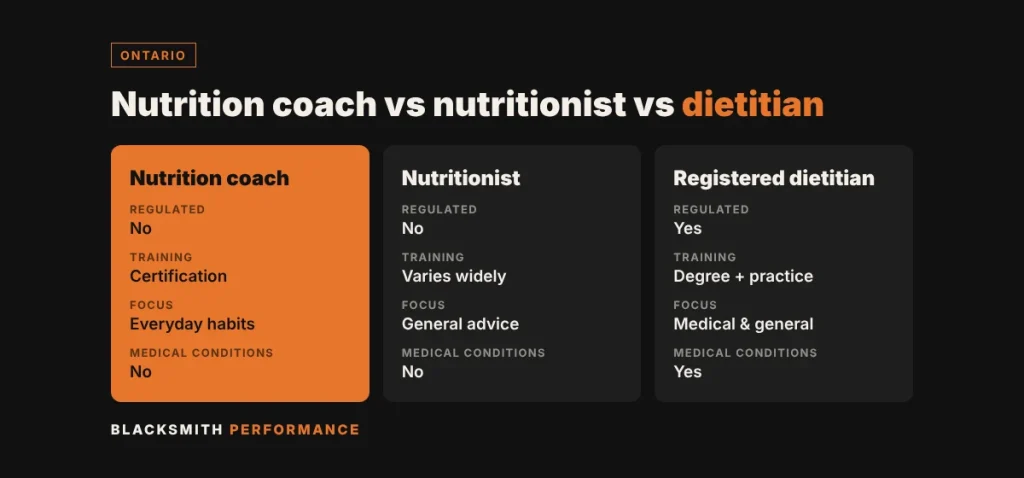
A nutritionist gives advice about food and eating, but in Ontario the title isn’t regulated. That means qualifications range from university degrees to short online courses (College of Dietitians of Ontario). Always ask what training a nutritionist has.
Nutritionist vs nutrition coach vs registered dietitian
| Nutrition coach | Nutritionist | Registered dietitian (RD) | |
| Regulated in Ontario? | No | No | Yes: College of Dietitians of Ontario |
| Typical training | Certification (e.g. Precision Nutrition) | Varies widely | University degree + supervised practice |
| Focus | Habits, behaviour change, everyday eating | General nutrition advice | Medical nutrition therapy and general nutrition |
| Can treat medical conditions? | No | No | Yes |
| Best for | Healthy people with fitness or body-composition goals | Depends on their training | Diabetes, kidney disease, eating disorders, allergies, GI conditions |
A nutrition coach in Toronto typically focuses on the day-to-day: building meals around protein and vegetables, planning around a busy work week, eating out, portion awareness and consistency. They don’t write meal plans to treat a disease.
Where Personal Trainers and Nutritionists Overlap
Both want you to feel better, perform better and reach your goal, and both rely on coaching and accountability. The overlap is biggest for:
- Fat loss: results depend on both training and eating habits.
- Muscle gain: strength training builds muscle; protein and total food intake support it.
- Energy and performance: what and when you eat affects how you train. See what to eat before a workout.
- Habits: sleep, stress and routine affect both training and eating.
That overlap is why a personal trainer nutritionist, or more accurately a trainer who is also a certified nutrition coach, can be useful: one person sees the whole picture and adjusts both sides together.
Personal Trainer vs Nutritionist: When Do You Need Both?
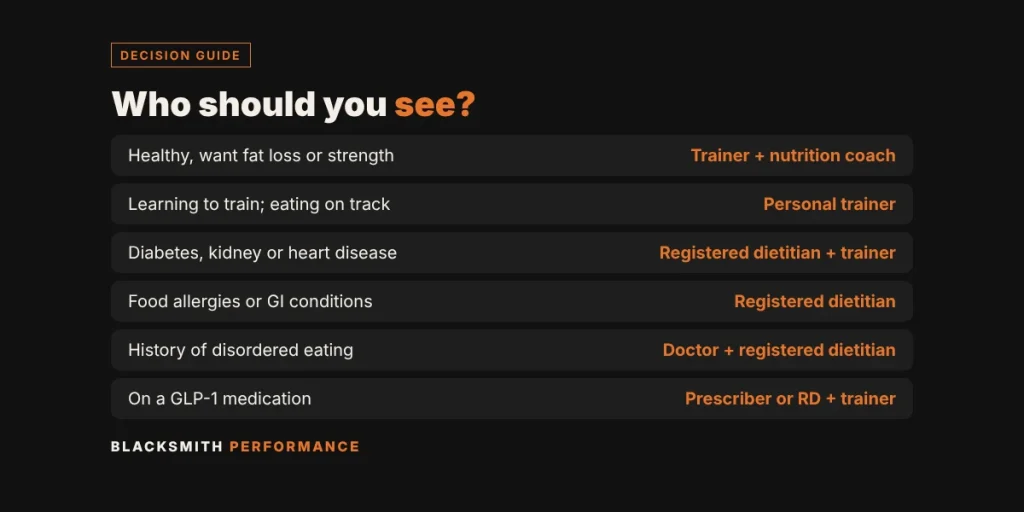
| Your situation | Who to see |
| Healthy, want to lose fat or get stronger | A personal trainer who is also a nutrition coach |
| Want to learn to train safely; eating is already on track | A personal trainer |
| Diabetes, kidney or heart disease, GI conditions, food allergies | A registered dietitian (plus a trainer for exercise) |
| History of, or signs of, disordered eating | Your doctor and a registered dietitian first |
| Pregnant or managing a medical diet | Your doctor and a registered dietitian |
| On GLP-1 medication such as Ozempic or Wegovy | Your prescriber or a dietitian for medical questions; a trainer to protect muscle |
| Athlete with performance goals | A trainer plus a sports dietitian or qualified nutrition coach |
If you’re using a GLP-1 medication, read our guide to Ozempic muscle loss for how strength training helps protect muscle.
What a Combined Training and Nutrition Plan Looks Like
When one coach handles both, the plan is built around the same goal, schedule and check-ins. A typical approach looks like this:
- Assessment: your goals, training history, health, schedule and current eating habits.
- Training program: strength sessions planned around your week, plus daily activity targets.
- One or two habits at a time: for example, protein at every meal, then a vegetable with lunch and dinner.
- Weekly check-ins: training progress, energy, sleep and how the habits are going.
- Adjustments: the plan changes when work gets busy, progress stalls or you travel.
- Referral when needed: a good coach refers you to your doctor or a registered dietitian if something is outside their scope.
This works especially well for weight loss, where training and eating need to move together. Read more about what actually works with a personal trainer for weight loss.
How Much Does It Cost?
Paying a trainer and a separate nutrition professional usually costs more than one combined plan, and you have to coordinate two sets of advice. In Toronto, one-on-one personal training typically costs about $60–$180 per session before HST (full cost guide). Registered dietitian services may be covered by some extended health plans; check your benefits.
Training and Nutrition at Blacksmith Performance
At Blacksmith Performance, Will Haywood is a canfitpro-certified trainer and Precision Nutrition Level 2 coach, so your training and nutrition coaching come from one plan built around your goals, schedule and food preferences. We coach habits, not restrictive diets, and refer to a registered dietitian when medical nutrition care is needed.
- Personal training in downtown Toronto
- Online fitness coaching if you train on your own
Personal Trainer vs Nutritionist: FAQs
Do I need a personal trainer and a nutritionist?
Not always. If you’re healthy and your goal is fat loss, strength or general fitness, a personal trainer who is also a certified nutrition coach can usually cover both. If you have a medical condition affected by diet, see a registered dietitian as well.
Can a personal trainer give nutrition advice?
Yes, within limits. Personal trainers can share general healthy eating guidance, and those with a nutrition coaching certification can coach everyday eating habits. They shouldn’t prescribe diets to treat medical conditions; that’s the role of a registered dietitian.
What’s the difference between a nutritionist and a dietitian in Ontario?
“Dietitian” is a protected title in Ontario, so only members of the College of Dietitians of Ontario can use it. “Nutritionist” isn’t protected, so qualifications vary. Registered dietitians can provide medical nutrition therapy.
What does a nutrition coach in Toronto do?
A nutrition coach helps you build sustainable eating habits for goals like fat loss, muscle gain and energy, such as planning meals around a busy schedule, eating enough protein and staying consistent. Nutrition coaches don’t treat medical conditions.
Is it better to have one coach for training and nutrition?
For most healthy people, yes. One coach can adjust training and eating together, keep the advice consistent and track progress in one place, which is usually simpler and more affordable than working with two separate professionals.
The Bottom Line
A personal trainer builds your fitness; a nutrition professional shapes your eating. If you’re healthy, a trainer who is also a certified nutrition coach can bring both together in one plan. If you have a medical condition, add a registered dietitian to your team.
Get training + nutrition in one plan. Book a free consultation with Blacksmith Performance to talk about your goals.
Note: This article is general information, not medical or dietary advice. Talk to your doctor or a registered dietitian about any medical condition.