
You have tried the apps, the 30-day challenges and the new year gym membership. The scale moved for a few weeks, then life got busy and it crept back. If that sounds familiar, the problem usually isn’t willpower. It’s the lack of a plan that fits your body, your schedule and your starting point.
A good personal trainer for weight loss gives you that plan: strength training to protect muscle, enough cardio and daily movement to support a calorie deficit, simple nutrition habits, and weekly check-ins that keep you consistent. Results come from doing those things for months, not from one intense week.
This guide explains what actually works for sustainable fat loss, what a structured program with a trainer looks like, a realistic sample week, how progress should be measured, and what to expect in your first 12 weeks. It is written for people in Toronto who want professional guidance, including beginners and anyone who has struggled to get results on their own.
Key takeaways
- Fat loss comes mainly from a sustained calorie deficit. Exercise helps, but combining diet changes with activity works better than either alone.
- Strength training is essential during weight loss because it helps you keep muscle while you lose fat.
- A realistic goal for many people is losing 5–10% of body weight over about 6 months. Even 3–5% kept off can improve health.
- Sleep, stress and consistency matter as much as the workouts themselves.
- Track more than the scale: waist measurements, strength, photos and how your clothes fit.
What actually works for sustainable weight loss
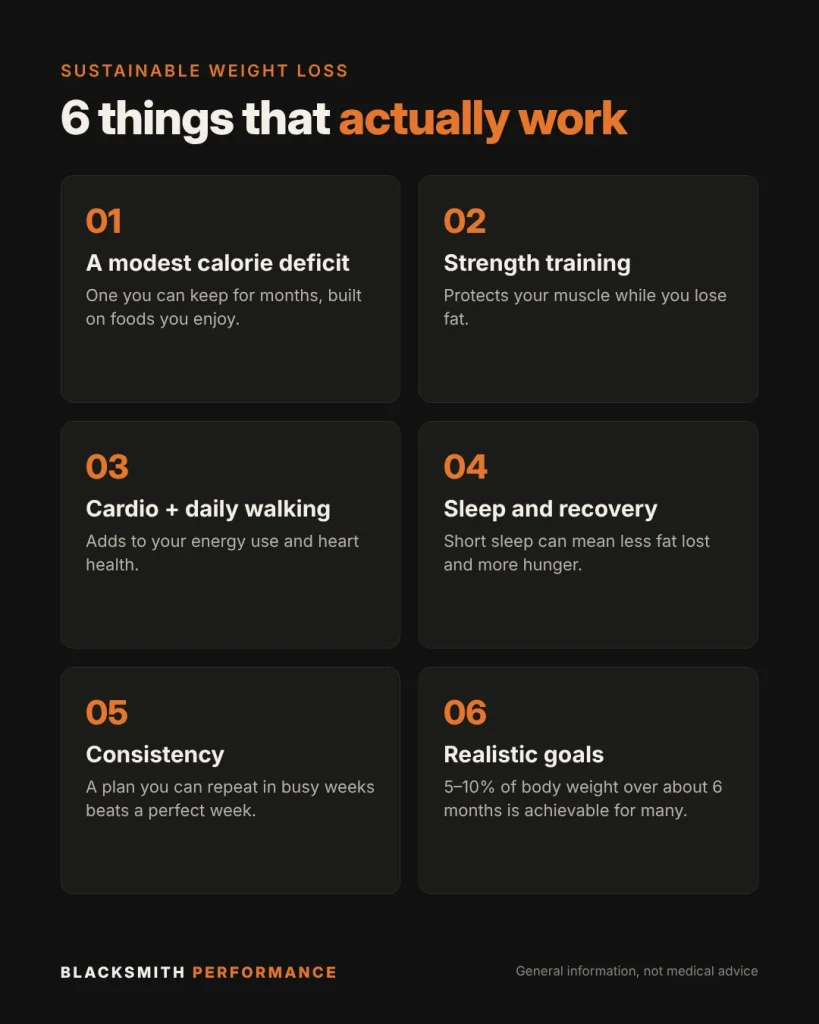
There is no single secret. Sustainable fat loss comes from a handful of habits done consistently, adjusted to you.
1. A modest, sustained calorie deficit
To lose fat, you need to take in less energy than you use over time. Extreme diets usually backfire because they are hard to maintain. A modest deficit you can live with, built on foods you enjoy, works better over months. There is no single “best” macronutrient split for weight loss: Alberta Health Services’ adult obesity nutrition guideline notes that no macronutrient distribution is superior to another for weight loss, and that calorie targets differ from person to person (AHS, 2020).
2. Strength training to keep your muscle
When you lose weight, some of what you lose is muscle. Strength training is the best tool you have to limit that. Canada’s obesity clinical practice guidelines note that weight-loss programs that include exercise generally maintain or even increase fat-free mass, and that resistance training may support modest gains in muscle (Obesity Canada). Keeping muscle helps you stay strong, look more toned as fat comes off, and makes daily life easier.
3. Cardio and daily movement
Cardio burns energy and improves heart health, but on its own it usually produces modest weight loss. The American College of Sports Medicine found that 150–250 minutes a week of moderate activity leads to only modest weight loss, that more than 250 minutes a week is associated with more meaningful loss, and that combining diet changes with activity increases weight loss compared with diet alone (ACSM position stand, 2009). Walking counts: in Toronto, that can mean getting off the TTC a stop early, walking the PATH in winter or the waterfront trail in summer.
4. Sleep and recovery
Poor sleep makes fat loss harder. In a small controlled study, people on the same calorie-reduced diet lost less fat and more lean mass when sleep was limited to 5.5 hours a night compared with 8.5 hours, and they reported more hunger (Nedeltcheva et al., Annals of Internal Medicine, 2010). Aim for 7–9 hours, and plan rest days into your week.
5. Consistency over perfection
Three solid workouts a week for six months beat six perfect workouts in one week followed by burnout. The most effective plan is the one you can repeat during busy weeks, travel and holidays.
6. Realistic expectations
Weight loss is rarely a straight line. Water, salt, hormones and stress can make the scale jump day to day. Alberta Health Services’ guideline describes losing 5–10% of body weight over 6 months as achievable, and notes that even 3–5% maintained can produce clinically relevant health improvements (AHS, 2020). Be wary of anyone promising dramatic results in a few weeks.
How a personal trainer helps you lose weight
You don’t need a trainer to lose weight, but a good one makes it far more likely that you will follow a plan long enough to see results. Here is what a weight loss fitness trainer adds:
- A plan built for you: your starting fitness, injuries, schedule and preferences shape the program.
- Safe, effective strength training: coaching on technique, so you can progress without getting hurt.
- Progression: small, planned increases in weight, reps or difficulty, so your body keeps adapting.
- Accountability: a booked session and weekly check-ins make it much harder to skip.
- Nutrition habits that fit real life: simple changes to meals and snacks, not a rigid meal plan.
- Adjustments when progress stalls: changes to training, steps or nutrition based on your data, not guesswork.
At Blacksmith Performance, our head coach Will Haywood is a canfitpro-certified trainer and Precision Nutrition Level 2 coach, so training and nutrition are planned together. Learn more about our personal training in downtown Toronto.
What a weight-loss training plan looks like
Every plan should start with you, not a template. Two people who want to lose 10 kg can need very different programs depending on age, injuries, training history and how much time they have.
Weeks 1–4: build the foundation
Learn the main movement patterns (squat, hinge, push, pull, carry), build a walking habit and set up two or three nutrition habits, such as protein at each meal and a planned afternoon snack. Workouts feel manageable on purpose.
Weeks 5–8: build strength and work capacity
Weights go up gradually, sessions get a little denser, and cardio increases. Nutrition focuses on consistency on weekends and busy days.
Weeks 9–12: push, then reassess
Training becomes more challenging, and you compare your measurements, strength and habits with week one. The next phase is planned from what worked.
Sample week: a realistic weight-loss training plan
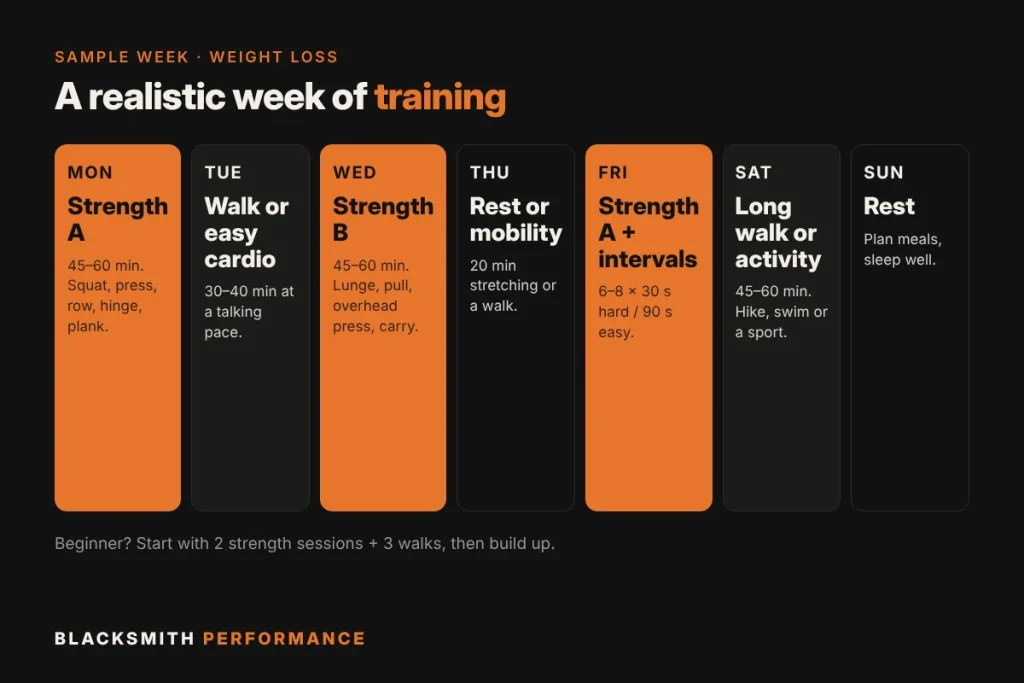
This is an example for a healthy beginner to intermediate adult with about 4–5 hours a week. Your own program should match your fitness, health and schedule.
| Day | Session | What it looks like |
| Monday | Strength A (45–60 min) | Goblet squat, dumbbell bench press, single-arm row, Romanian deadlift, plank. 2–3 sets each. |
| Tuesday | Walk or easy cardio (30–40 min) | Brisk walk, bike or elliptical at a pace where you can talk in full sentences. |
| Wednesday | Strength B (45–60 min) | Split squat, lat pulldown, overhead press, hip thrust, farmer’s carry. 2–3 sets each. |
| Thursday | Rest or mobility (20 min) | Light stretching, a walk, or a recovery session. |
| Friday | Strength A + short intervals | Strength A, then 6–8 rounds of 30 seconds harder / 90 seconds easy on a bike or rower. |
| Saturday | Long walk or activity (45–60 min) | A long walk, hike, swim or a sport you enjoy. |
| Sunday | Rest | Plan meals for the week and get to bed on time. |
Complete beginner? Start with two strength sessions and three 20–30 minute walks, then add the third session after a few weeks. Canada’s guidelines for adults recommend at least 150 minutes of moderate-to-vigorous aerobic activity and muscle-strengthening activities at least twice a week (CSEP). Fuelling matters too: see our guide on what to eat before a workout.
How progress is measured
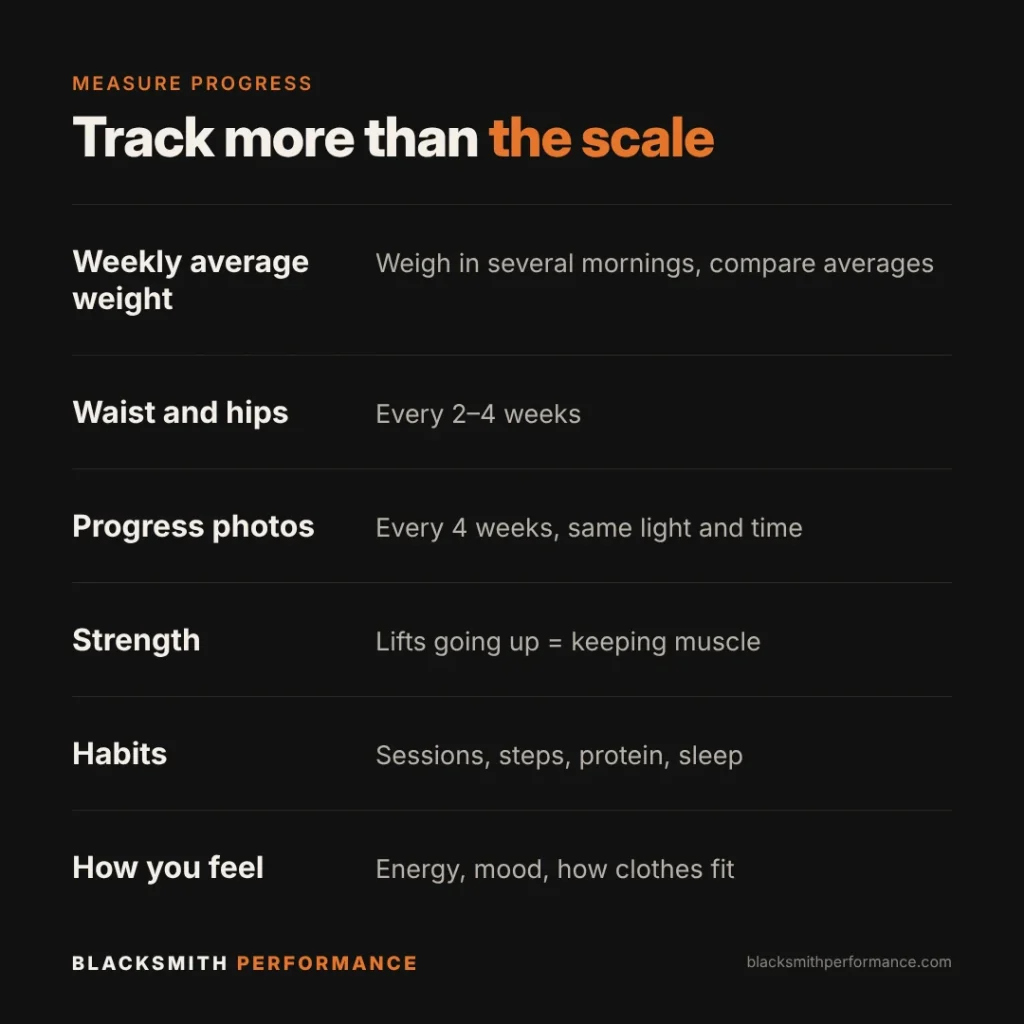
The scale is only one number. A good weight loss coach in Toronto, or anywhere, tracks a few things every week:
- Weekly average weight: weigh in the morning several days a week and compare averages, not single days.
- Waist and hip measurements: every 2–4 weeks.
- Progress photos: every 4 weeks, same lighting and time of day.
- Strength: are your main lifts going up? That is a sign you are keeping muscle.
- Habits: sessions completed, daily steps, protein and sleep.
- How you feel: energy, mood, and how your clothes fit.
If the scale hasn’t moved for 2–3 weeks but your waist is shrinking and you are getting stronger, the plan is working. If nothing is changing, your coach adjusts one thing at a time.
Why individual goals and fitness levels matter
A 28-year-old who used to play sports, a 45-year-old parent with a sore knee and a 62-year-old starting for the first time all need different programs. Medical conditions, medications, past injuries, sleep, work stress and food preferences change what is safe and realistic. If you have a health condition, are taking medication that affects weight or appetite, or have a history of disordered eating, talk to your doctor first. If you are using a GLP-1 medication, read our guide to keeping muscle on Ozempic.
Client story
[PLACEHOLDER: CLIENT TRANSFORMATION STORY, ADD ONLY WITH WRITTEN PERMISSION] Use a real Blacksmith client who has agreed to share their story. Include: their starting point and goal, how often they trained, what changed in their habits, results over a stated time frame (for example, waist measurement, strength or weight), and a short quote in their own words. Add a photo only with signed consent. Do not publish this section until it has been verified.
Is personal training for weight loss right for you?
It is a good fit if you:
- Have tried on your own and lost motivation or hit a plateau
- Are new to strength training and want to learn safe technique
- Have a busy schedule and need a plan that fits around it
- Want accountability and someone to adjust the plan as you go
If budget is a concern, our guide to personal trainer costs in Toronto compares one-on-one, semi-private and online options.
Personal trainer for weight loss: frequently asked questions
Can a personal trainer help me lose weight?
Yes. A personal trainer helps you follow a structured plan of strength training, cardio and nutrition habits, and keeps you accountable. Fat loss still depends mainly on a sustained calorie deficit, so the best results come from combining training with changes to how you eat.
How often should I train with a personal trainer to lose weight?
Two to three strength sessions a week is a good target for most people, plus daily walking or other cardio. Many people see a trainer once or twice a week and follow a written program on the other days.
How long does it take to see results?
Many people notice better energy and strength within a few weeks. Visible changes often take 8–12 weeks or longer of consistent training and nutrition. Losing 5–10% of body weight over about 6 months is a realistic goal for many people.
Is personal training good for beginners?
Yes. Beginners often benefit the most, because a trainer teaches safe technique, sets the right starting level and progresses the program gradually.
Is cardio or weight training better for weight loss?
Both help. Strength training protects muscle while you lose fat, and cardio adds to your energy use and heart health. A combination, with a calorie deficit, works best.
Do I need to diet to lose weight with a trainer?
You need to change how you eat, but not with a crash diet. Small, sustainable habits, such as more protein, more vegetables, planned snacks and fewer liquid calories, usually work better over months.
What is a body transformation plan?
A body transformation plan is a structured program, often 12 weeks or longer, that combines progressive strength training, cardio, nutrition habits and regular progress checks to change body composition: losing fat while keeping or building muscle.
Where can I find a weight loss coach in Toronto?
Blacksmith Performance offers personal training in downtown Toronto and online coaching across Canada, with training and nutrition coaching planned together. Book a free consultation to see whether it is the right fit.
Start your 12-week fat-loss program
If you are ready for a plan that fits your life, our 12-week fat-loss program combines personal training, nutrition coaching and weekly check-ins, starting with an assessment of where you are today. Book a free consultation and we will talk through your goals, schedule and the best way to get started. Want nutrition support on its own? See our nutrition coaching [ADD LINK: Nutrition Coaching page].
Health note: This article is general information, not medical advice. Talk to your doctor before starting a new exercise or weight-loss program, especially if you have a medical condition, take medication, are pregnant or have a history of disordered eating. Results vary from person to person.