
Canadian employers are planning to spend more on wellness just as employees say they feel worse. In 2026, 45% of HR leaders expected their well-being investment to rise through 2027 (Dialogue, 2026), while the share of working Canadians who rated their overall wellbeing as good or excellent fell from 65% to 56% in a year (RBC Insurance/Ipsos, 2026).
So where should that money go? We reviewed the major 2026 Canadian workplace surveys to find the corporate wellness trends that will shape 2027, and what each one means for a Toronto office. If you’re new to the topic, start with what is a corporate wellness program, or see our corporate wellness programs in Toronto.
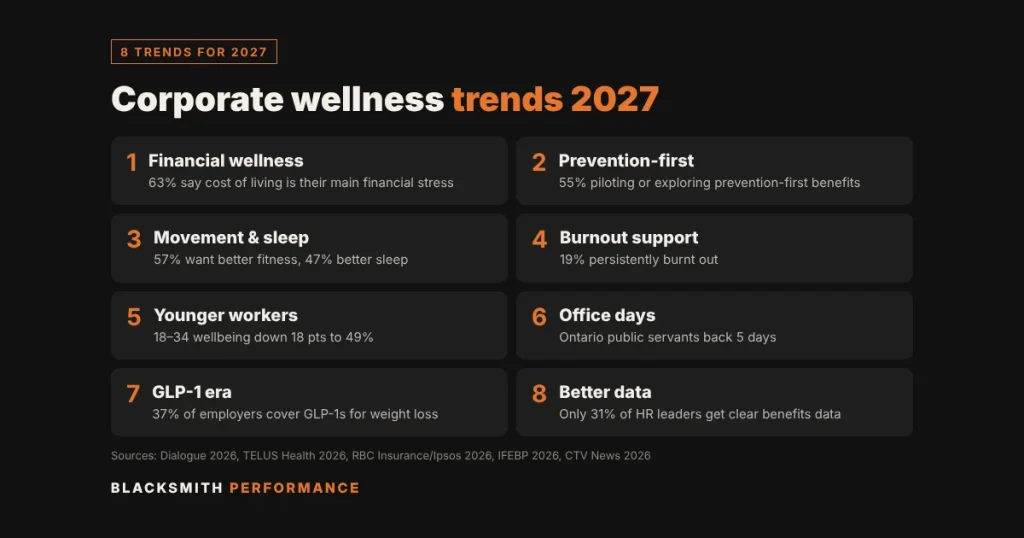
Quick answer: the biggest corporate wellness trends for 2027 are financial wellness, prevention-first benefits, a renewed focus on movement and sleep, practical burnout support, programs for younger workers, making office days worth the commute, health support for the GLP-1 era and better measurement.
The 8 Corporate Wellness Trends for 2027
1. Financial wellness moves to the centre
Money is now the top wellbeing concern for Canadian workers. In TELUS Health’s 2026 Mental Health Index, 63% of workers named the cost of living as their main source of financial stress, and 20% said financial stress had hurt their productivity. Sixty-three percent want more support from their employer to understand retirement and savings plans (TELUS Health, 2026). Employers are responding: 32% of HR leaders list financial well-being as a focus area, and 49% of employees rank their financial situation as a top priority (Dialogue, 2026).
What it means for a Toronto office: add a practical financial wellness workshop on budgeting, debt and making the most of your workplace benefits, especially before RRSP season.
2. Prevention-first benefits replace reactive ones
Instead of paying only after people get sick or hurt, more employers are funding prevention. About 1 in 4 organizations already use a prevention-first benefits model, and 55% are piloting or exploring one (Dialogue, 2026).
What it means for a Toronto office: put budget into things employees use before problems start, such as movement breaks, on-site stretch therapy, sleep education and health screenings, rather than relying only on claims.
3. Physical health, fitness and sleep are back on the agenda
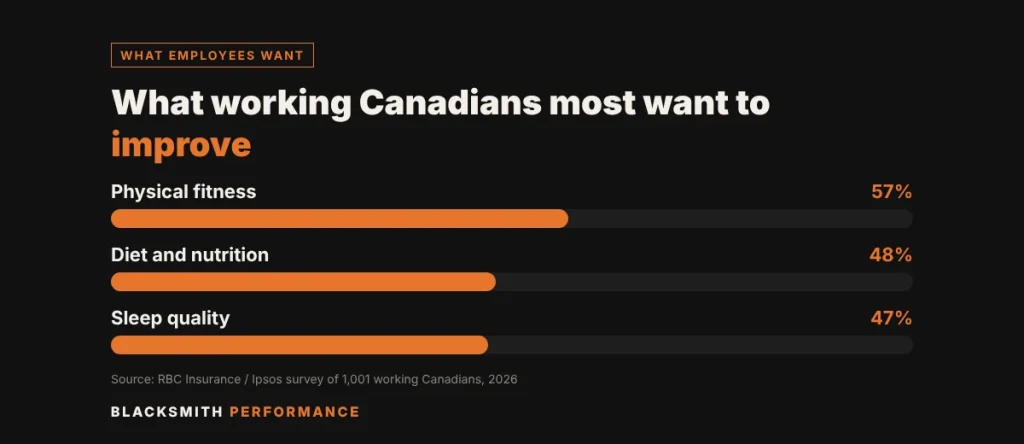
Physical health is slipping. Only 53% of working Canadians rated their physical health as good or excellent in 2026, down 6 points. When asked what they most want to improve, 57% said physical fitness, 48% diet and nutrition and 47% sleep, and sleep quality (66%) and fitness (55%) were the factors with the biggest impact on overall wellbeing (RBC Insurance/Ipsos, 2026). Physical health is also a top-three priority for 43% of employees (Dialogue, 2026).
What it means for a Toronto office: short, easy-to-join options work best: 30-minute group movement sessions, bookable stretch therapy and sleep workshops. Compare the formats in our guide to corporate fitness programs.
4. Burnout support gets more practical
Burnout hasn’t gone away. In 2026, 19% of Canadian employees said they feel persistently burnt out and another 31% cycle between burnout and recovery. More than a third (35%) said their mental health worsened over the past year, and 46% find mental health support hard to access (Dialogue, 2026). TELUS Health’s Mental Health Index stood at 63.9 in mid-2026 (TELUS Health, 2026).
What it means for a Toronto office: go beyond promoting the EAP. Offer stress and recovery workshops, train managers to spot burnout and make it easy to take short breaks during the day.
5. Programs built for younger workers
Younger employees are struggling most. Overall wellbeing among Canadians aged 18–34 fell 18 points to 49% in 2026 (RBC Insurance/Ipsos, 2026), and workers under 40 are three and a half times more likely than those over 50 to say financial stress affects their productivity (TELUS Health, 2026).
What it means for a Toronto office: ask younger staff what they want rather than guessing. Topics like money, sleep and fitness, plus flexible formats (virtual sessions, bookable time slots), tend to land well.
6. Making office days worth the commute
Return-to-office rules are tightening. In January 2026, provincial employees in Ontario and Alberta were expected back in the office five days a week (CTV News, 2026), and many private employers have also increased in-office days.
What it means for a Toronto office: use anchor days for things people can only get on-site, such as on-site stretch therapy days, group movement sessions and lunch-and-learns, so the office feels like a perk, not just a commute.
7. Wellness for the GLP-1 era
Coverage for GLP-1 medications such as Ozempic and Wegovy is spreading fast. In 2026, 37% of Canadian employers covered GLP-1 drugs for weight loss, up from 17% in 2024. Only 24% also covered lifestyle modification programs (IFEBP, 2026).
What it means for a Toronto office: pair medication coverage with support for strength training, protein and habits. Rapid weight loss can include muscle loss, so learn more in our guide to Ozempic muscle loss.
8. Better data and measurement
HR teams want proof that programs work, but only 31% of HR leaders regularly receive clear, actionable data from their benefits provider (Dialogue, 2026).
What it means for a Toronto office: track simple numbers from day one: participation rate, how quickly sessions fill, repeat attendance and short feedback surveys. See how to tell if your wellness program is working.
Corporate Wellness Trends 2027 at a Glance
| Trend | Key 2026 data | Toronto office action |
|---|---|---|
| Financial wellness | 63% say cost of living is their main financial stress | Financial wellness workshop |
| Prevention-first | 55% piloting or exploring prevention-first benefits | Fund movement, stretch, sleep |
| Movement and sleep | 57% want better fitness; 47% better sleep | Group sessions, stretch therapy |
| Burnout support | 19% persistently burnt out | Stress workshops, manager training |
| Younger workers | 18–34 wellbeing down 18 points to 49% | Ask them; flexible formats |
| Office days | Ontario public servants back 5 days | On-site perks on anchor days |
| GLP-1 era | 37% cover GLP-1s for weight loss | Strength and nutrition support |
| Better data | 31% get clear benefits data | Track 4–5 simple metrics |
How to Plan Your 2027 Wellness Budget
- Survey your team on what they want and when they can take part.
- Pick two or three trends that match the answers, rather than trying everything.
- Pilot in Q1, for example one stretch therapy day and one workshop.
- Measure participation and feedback.
- Scale what works for the rest of the year.
Corporate Wellness Trends: FAQs
What are the biggest corporate wellness trends for 2027?
Based on 2026 Canadian surveys, the biggest corporate wellness trends for 2027 are financial wellness, prevention-first benefits, movement and sleep, practical burnout support, programs for younger workers, making office days worthwhile, support alongside GLP-1 medications and better measurement.
Are Canadian employers spending more on wellness in 2027?
Many are. In a 2026 Dialogue and Leger survey, 45% of Canadian HR leaders said they expect their well-being investment to increase through 2026 and 2027.
What wellness support do Canadian employees want most?
In a 2026 RBC Insurance and Ipsos survey, working Canadians most wanted to improve their physical fitness (57%), diet and nutrition (48%) and sleep (47%). Financial security is also a major concern: 49% rank their financial situation as a top priority.
How can a small company keep up with corporate wellness trends?
Start small. Survey your team, choose two or three trends that match what they want, run a pilot such as a stretch therapy day or workshop, and track participation and feedback before expanding.
Is financial wellness part of corporate wellness?
Yes. Financial wellness is one of the main types of corporate wellness, and it’s one of the fastest-growing trends in corporate wellness because cost of living is the top source of financial stress for Canadian workers.
Plan Your 2027 Program
The trends point the same way: employees want practical help with money, movement, sleep and stress, and employers want programs people actually use. Start with what your team asks for, make it easy to join during the workday and measure the results.
Blacksmith Performance delivers on-site stretch therapy, 30-minute movement sessions and workshops on sleep, stress, nutrition, financial wellness and movement at work for Toronto teams.
Book a corporate wellness discovery call to plan your 2027 workplace wellness program.